Boilers & Radiant Heat
When homeowners describe the “best heat they’ve ever had,” the system type they mention most often isn’t a furnace — it’s a boiler. Boiler-based heating systems and their close relative, radradiant floor heating pros and cons iant floor heating, produce a warmth that forced-air systems simply can’t match: silent, even, draft-free heat that feels like standing in late morning sunlight. types of heating systemsThis guide covers the major types of boilers, how boiler heating systems work, radiant floor heating from installation to operation, efficiency benchmarks, and current installation costs.
What Are the Different Types of Boilers?
The three main boiler types for residential heating are hot water boilers, steam boilers, and comcombi boiler vs system boiler bi (combination) boilers — each serving different home configurations and heating needs. Compare boiler types →
Hot Water Boilers
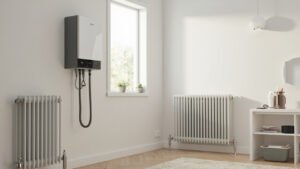
A hot water boiler heats water to temperatures typically between 140°F and 180°F (depending on outdoor reset settings — a feature that adjusts water temperature based on outdoor temperature to optimize efficiency). The heated water circulates through a closed loop of pipes to heat emitters: radiators, convectors, or radiant floor tubing. The water releases its heat and returns to the boiler to be reheated in a continuous cycle.
Hot water boilers are the most common type in modern residential installations. They’re efficient, controllable, and pair well with radiant floor heating systems. Most residential hot water boilers are now high-efficiency condensing units operating in the 90–98% AFUAFUE efficiency ratings E range.
A key advantage of hot water systems is zoning capability: each zone (typically each room or area) can have its own thermostat controlling a motorized valve, allowing precise temperature control in different parts of the home simultaneously. This means you can keep a finished basement at 65°F while maintaining the living room at 70°F, without compromising either.
Steam Boilers
A steam boiler heats water past the boiling point to produce low-pressure steam at approximately 212°F (or slightly above, depending on altitude). This steam rises through pipes to radiators, where it condenses back to water and releases the latent heat it carried. The condensed water returns to the boiler through a separate pipe called a dry return — so named because it sits above the water line and stays dry.
Steam systems were the dominant heating technology in homes built before roughly 1940. They’re less common in new construction today, but millions of steam systems are still operating in older homes in northeastern U.S. cities. Steam boilers tend to be less efficient than hot water boilers and more complex to service, but they offer excellent heating performance in the right applications — particularly in tall buildings where the steam’s natural rise helps overcome gravitational head.
The key component in a steam system is the steam trap — a small, inexpensive automatic valve installed at each radiator that allows steam to enter but prevents steam from escaping as it condenses. Failed steam traps are the most common cause of heating inefficiency in steam systems and are a frequent maintenance item.
Combi (Combination) Boilers
A combi boiler (short for “combination boiler”) provides both space heating and domestic hot water heating from a single compact unit. Unlike a conventional boiler, which requires a separate storage tank for hot water, a combi boiler heats water on demand — when you open a hot water tap, the boiler fires and heats incoming cold water directly, providing unlimited hot water without a storage tank.
Combi boilers are the standard in most of Europe and are increasingly popular in the U.S. market, particularly in smaller homes, condominiums, and apartments where space for a hot water tank is at a premium. They offer excellent efficiency (typically 90–95% AFUE) and a small mechanical footprint.
The trade-off is flow rate. A combi boiler can heat water very quickly, but there’s a limit to how many simultaneous hot water outlets it can serve. In a typical installation, running a hot water shower and a kitchen sink tap simultaneously may reduce water pressure at both. For a family of four or more, a combi boiler may not be the right choice unless hot water use is carefully managed or a storage buffer tank is added.
How Does a Boiler Heating System Work?
A boiler heating system works by heating water (or producing steam) in a sealed vessel and circulating it through pipes to heat emitters throughout the home, where it releases thermal energy and returns cooled to the boiler for reheating. Unlike forced-air systems that blow hot air through ducts, boilers distribute heat silently through water or steam — a medium that holds far more thermal energy per degree of temperature increase than air does.
Hot Water Circulation
In a hot water boiler system, heated water leaves the boiler at typically 140–180°F and travels through insulated pipes to heat emitters in each room. The circulation can be driven by:
- Natural convection: Heated water rises naturally through the pipes, and cooler water returns — a passive process requiring no pump. This is how older gravity-fed hot water systems operated.
- Forced circulation: A circulator pump (essentially a sealed electric pump) drives water through the pipes at a controlled rate. This is how all modern hot water systems operate, enabling faster, more predictable heat delivery and the ability to zone different areas independently.
Zoning is achieved through zone valves — motorized valves that open or close based on signals from a room thermostat. When a zone calls for heat, its valve opens and hot water flows to that area’s heat emitters. The boiler responds to any zone calling for heat and modulates its output accordingly.
Outdoor Reset Control
One of the most significant efficiency features in modern boiler systems is outdoor reset control — a sensor that measures outdoor temperature and adjusts the boiler’s water temperature accordingly. On a mild 40°F day, the boiler might heat water to only 100°F — enough to maintain comfortable room temperatures with less energy input. On a frigid 0°F day, it raises water temperature to 160°F or higher to compensate for faster heat loss from the home.
Without outdoor reset, a boiler produces the same water temperature regardless of conditions, wasting energy in mild weather and struggling to keep up in extreme cold. A properly configured outdoor reset curve can improve seasonal efficiency by 8–15% compared to a fixed-temperature system.
Steam System Operation
In a steam system, the boiler heats water until it produces steam at approximately 212°F and low pressure (typically 1–5 psi in residential systems). The steam rises through pipes to the radiators. As steam contacts the cooler surfaces of the radiator, it condenses back to water, releasing the latent heat of vaporization — the same principle that makes a steam burn far more damaging than hot water at the same temperature.
Each radiator has a steam trap at the inlet that allows steam in but prevents steam from escaping. As steam enters and condenses, the water level inside the radiator rises. When the thermostat satisfied and the boiler shuts off, the steam pressure drops, and the condensed water drains back toward the boiler through the dry return pipe.
Steam systems require careful air venting — every radiator and pipe must be able to push air out ahead of the arriving steam, or the steam won’t fill the radiator fully. This is why steam systems have air vents on each radiator, typically located at the far end opposite the steam trap.
What Is Radiant Floor Heating and How Does It Work?
Radiant floor heating is a system that delivers heat directly to the underside of your floors, warming the floor surface and the room above through direct thermal radiation rather than forcing hot air through ducts. Learn about radiant floor heating pros and cons →
Hydronic Radiant Floor Heating
The most common and efficient form of radiant floor heating is hydronic — meaning it uses hot water circulated through tubes embedded in or beneath the floor structure. A typical hydronic radiant system consists of:
- A heat source (boiler, heat pump, or water heater)
- A circulator pump and manifold that distribute hot water to multiple zones
- PEX (cross-linked polyethylene) tubing or sometimes rubber hoses, run in loops beneath the floor
- A method of securing the tubing to the subfloor or embedding it in concrete
The hot water typically runs at 85–140°F — substantially cooler than the water in a typical baseboard or radiator system. This lower temperature requirement makes hydronic radiant floor systems an excellent match for condensing boilers and heat pumps, both of which operate most efficiently at lower water temperatures.
The tubing is installed either:
- In or under a concrete slab (on-grade or in a basement)
- In aluminum heat transfer plates attached to the underside of the subfloor (wood-framed floors)
- Sandwiched between two layers of subfloor in a wood-frame construction
Each method has trade-offs in cost, heat output, and response time. Concrete slab systems have the highest installation cost but provide the most even temperature distribution and the best thermal mass. Plate systems are faster to install and work well in renovation projects where slab access isn’t available.
Electric Radiant Floor Heating
Electric radiant floor heating uses resistance heating cables installed beneath flooring materials — tile, stone, engineered wood, or even carpet with appropriate padding. Unlike hydronic systems, electric radiant doesn’t require a boiler; it connects directly to the home’s electrical system.
The appeal of electric radiant is its simplicity: no boiler, no pipes, no circulator pumps. The system is controlled by a wall-mounted thermostat, and warm-up time is relatively fast (30–60 minutes depending on floor construction). It’s well-suited as a supplemental heat source in specific rooms — bathrooms, kitchens, entryways — where stepping onto a warm floor is a meaningful quality-of-life improvement.
The drawback is operating cost. Electricity is typically 3–4x more expensive per BTU than natural gas. An electric radiant floor heating system in a bathroom might cost $20–$40 per month to operate in winter, while the equivalent heat from a hydronic system fed by a gas boiler might cost $5–$15 per month. Electric radiant is rarely economical as a whole-home primary heat source except in areas with very low electricity rates.
Heat Distribution and Comfort
The comfort physics of radiant floor heating are genuinely different from forced air. In a forced-air system, warm air is delivered at typically 120–140°F through supply registers near the ceiling. It mixes with room air, cools as it rises, and eventually returns to the furnace. This creates a temperature gradient of 5–8°F from floor to ceiling — warmer near the ceiling, cooler near the floor.
Radiant floor heating inverts this gradient. The floor surface is warmed to roughly 75–80°F, releasing thermal radiation that heats objects and occupants directly. The air temperature near the floor is only slightly warmer than the floor surface itself, and the air temperature at ceiling level is actually the same or slightly cooler. The result is a warmth that many homeowners describe as “like sunlight” — gentle, even, and natural.
Because the heat source covers the entire floor area, there are no cold spots in a properly designed radiant system. Temperature variation across a room typically stays within 1°F — compared to the 3–5°F swings common in forced-air heated spaces.
How Efficient Is a Boiler System?
A modern high-efficiency boiler achieves efficiency ratings of 90–98% AFUE, and when paired with hydronic radiant floor heating, can outperform forced-air systems because it operates at lower water temperatures and loses less heat to duct leakage. The efficiency advantage compounds over the system’s lifespan: a boiler that lasts 20–35 years accumulates efficiency gains across a much longer payback horizon than a furnace with a 15–20 year lifespan.
Condensing vs. Non-Condensing Boilers
The efficiency distinction in boilers mirrors that in furnaces: condensing boilers (90–98% AFUE) capture latent heat from water vapor in the exhaust gases, while non-condensing boilers (80–88% AFUE) vent that heat unused.
In a condensing boiler, the exhaust gases are cooled below the dew point (~130°F), causing water vapor to condense and release latent heat that goes back into the system rather than out the flue. To achieve this, condensing boilers must have:
- A secondary heat exchanger to capture the latent heat
- A way to drain the condensate produced (a mild acidic fluid — typically pH 3–5 — that results from the condensation)
- PVC or stainless steel venting (not the traditional metal chimney flue used by non-condensing units)
Condensing boilers are now the default in most new residential installations due to their efficiency advantage and the declining cost premium. They’re particularly well-suited to radiant floor heating, which operates at lower water temperatures that allow the condensing mode to activate more readily.
Why Lower Water Temperatures Mean Higher Efficiency
When a boiler heats water to 160–180°F to serve cast iron radiators (which require higher temperatures to deliver enough heat), it operates in a mode that typically prevents condensation. When the same boiler heats water to 85–120°F for a radiant floor system, the return water temperature is low enough that the flue gases can condense, capturing significantly more of the fuel’s energy.
This is why a condensing boiler paired with radiant floor heating routinely achieves 95–98% AFUE, while the same boiler serving high-temperature radiators might only achieve 88–92% AFUE. The system design matters as much as the equipment efficiency rating.
Reducing System Losses
Like duct losses in forced-air systems, pipe losses in hydronic systems can reduce overall heating efficiency. Pipes running through unconditioned spaces (unfinished basements, crawl spaces, garages) lose heat to ambient air if they’re not insulated. Proper insulation of all hydronic pipes running through unconditioned space is one of the highest-ROI efficiency improvements available, and it’s almost always overlooked in the initial installation quote.
What Does a Boiler Cost to Install?
A new boiler installation costs between $4,000 and $10,000 for the equipment and labor combined, with prices varying by boiler type, efficiency tier, and whether the installation involves a complete system repboiler replacement cost lacement or a like-for-like swap. Radiant floor heating additions run $4–$22 per square foot depending on the method and whether it’s new construction or a renovation.
Boiler Equipment and Installation Costs
| Boiler Type | Equipment Cost | Installed Cost (with labor) |
|---|---|---|
| Standard Efficiency Hot Water Boiler (80–85% AFUE) | $1,500–$3,000 | $4,000–$7,000 |
| High-Efficiency Hot Water Boiler (90–95% AFUE) | $2,500–$5,000 | $5,500–$9,000 |
| Condensing Boiler (95–98% AFUE) | $3,500–$7,000 | $7,000–$12,000 |
| Combi Boiler | $2,500–$5,500 | $5,500–$10,000 |
| Steam Boiler | $2,000–$4,500 | $4,500–$8,500 |
For a like-for-like replacement of an existing boiler in a home with radiators already in place, the labor portion is typically $1,500–$3,000 — removal of the old boiler, setting of the new unit, and connection to existing piping. If the existing system requires modification (new piping runs, new radiators, or zone additions), costs scale up proportionally.
Radiant Floor Heating Installation Costs
| Installation Method | Cost Per Square Foot | Typical 2,000 sq ft Home |
|---|---|---|
| Slab-on-grade (new construction) | $8–$14 per sq ft | $16,000–$28,000 |
| Thin-slab over existing subfloor | $10–$18 per sq ft | $20,000–$36,000 |
| Aluminum heat transfer plates (wood floor) | $4–$8 per sq ft | $8,000–$16,000 |
| Electric radiant mat (per room) | $8–$15 per sq ft | $1,500–$4,000 per room |
These costs include tubing, manifold, insulation, and labor — but not the heat source. A full hydronic radiant system for a 2,000 sq ft home including the boiler and all installation could total $22,000–$45,000 in a new construction or major renovation scenario. However, the energy savings over a 20-year period typically range from $8,000–$20,000 compared to a standard forced-air system, partially offsetting the installation premium.
BTU Sizing for Boiler Replacement
Boiler sizing is based on heat loss calculations (similar to Manual J for furnaces), but boilers are typically sized to handle both space heating and domestic hot water simultaneously if a separate water heater isn’t used. For a combi boiler, the space heating and DHW outputs are specified separately — the space heating output might be 45,000–80,000 BTU/hr while the DHW output (measured in gallons per minute, or GPM) might be 2–5 GPM at a 70°F temperature rise.
An oversized boiler wastes fuel through frequent cycling, and in a condensing boiler, prevents the system from operating in condensing mode (which requires sustained lower-temperature operation). Proper sizing by a qualified heating contractor is one of the most important decisions in a boiler installation.
Frequently Asked Questions
What is the difference between a combi boiler and a conventional boiler?
A combi (combination) boiler provides both space heating and unlimited on-demand hot water from a single compact unit without a storage tank, while a conventional boiler requires a separate water heater tank to supply domestic hot water. Combi boilers eliminate the footprint of a storage tank and are more efficient at producing hot water because they only fire when hot water is needed. The trade-off is hot water flow rate — a combi boiler can typically serve only one or two simultaneous hot water outlets before experiencing a drop in temperature or flow rate.
How long does a boiler last?
A well-maintained boiler lasts 20–35 years, with cast iron units in particular often reaching 30+ years. The lifespan depends on water quality (hard water accelerates scale buildup in the heat exchanger), annual maintenance quality, and how many cycles the boiler performs annually. Hydronic systems with properly treated water and annual professional service routinely exceed 30 years of reliable operation.
Is radiant floor heating expensive to operate?
Radiant floor heating is economical to operate when it’s powered by an efficient heat source (gas boiler or heat pump) and is properly designed with adequate insulation beneath the tubing. A properly insulated hydronic radiant system powered by a high-efficiency condensing boiler typically costs 10–20% less to operate than a comparable forced-air system. Electric radiant systems, by contrast, are expensive to operate due to the high cost of electricity per BTU and are best used only for supplemental heating in small areas.
Can you add radiant floor heating to an existing home?
Yes — radiant floor heating can be added to existing homes using either thin-slab methods (pouring a 1–1.5 inch concrete layer over the existing subfloor), aluminum heat transfer plates installed under the floor, or electric radiant mats installed directly under flooring. Each approach has trade-offs in cost, heat output, and impact on floor height (and therefore door and transition clearances). Retrofit radiant floor heating is most commonly installed in kitchen and bathroom renovations where the floor is already being replaced.
What is zoning in a boiler system?
Zoning in a boiler system means dividing the home’s heating into multiple independently controlled areas, each with its own thermostat and zone valve, so that different rooms or floors can be maintained at different temperatures simultaneously. Zoning is one of the most valuable features of hydronic boiler systems and is typically achieved through motorized zone valves controlled by individual room thermostats. The boiler responds whenever any zone calls for heat, but each zone independently controls its own heat output, preventing over-heating in some areas while others are cold.