
Electric Heating Systems
Electric heatypes of heating systems ting systems are the simplest, most durable, and most widely available heating technology available — and, in most U.S. markets, the most expensive to operate. Understanding where and when electric heat makes sense requires cutting through a common misconception: electric heat isn’t inherently inefficient. What it is, is expensive per unit of heat. The distinction matters enormously when evaluating heating options for your home.
This guide covers the major types of electric heating systems, how electric heat actually works, the real operating cost economics, how electric heating efficiency compares to gas, and the specific scenarios where electric baseboard heaters and other electric heating technologies are genuinely the right choice.
What Are the Different Types of Electric Heating Systems?
The main categories of electric heating systems are electric baseboard heaters, electric furgas furnaces naces, electric radiant heaters (panel and floor), and thermal storage heaters — each using a different mechanism to convert electrical energy into thermal energy for your home. The category that makes sense depends on whether you’re heating a whole home, a single room, or a supplemental zone, and whether your primary concern is upfront cost or operating economy.
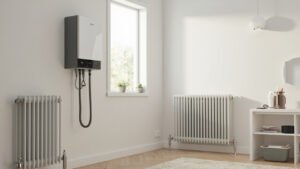
Electric Baseboard Heaters
Electric baseboard heaters are the most common form of electric heating in homes and apartments without central heating systems. Learn about electric baseboard heater costs →
Baseboard heaters are typically sized at 250–400 watts per linear foot of length. A standard 6-foot baseboard heater delivers approximately 1,500 watts at full output, which is roughly 5,100 BTU/hr — adequate for a small-to-medium room in a reasonably insulated home.
Each baseboard heater is independently controlled by a thethermostat settings for efficiency rmostat (either built into the unit or mounted on the wall nearby), allowing room-by-room temperature control. There’s no ductwork, no central fan, no combustion, and no flue. The simplicity of the design is both its greatest strength and its primary limitation.
Electric Furnaces
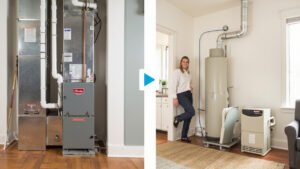
An electric furnace is a central heating system that works on the same forced-air principle as a gas furnace — blow air across a heat exchanger, distribute warm air through ducts — but uses electric resistance elements instead of combustion to generate heat. The heat exchanger consists of electric resistance coils (nickel-chromium wire loops inside metal housings) that glow red-hot when current flows through them. A blower fan forces air across these hot coils and into the duct system.
Electric furnaces are simple, reliable, and inexpensive to install — typically $1,500–$3,500 for the unit and $3,000–$6,000 installed. They can be installed anywhere (no gas line, no flue, no condensate drain required), making them the default choice in homes without gas service.
The problem is operating cost. An electric furnace converts electricity to heat at essentially 100% efficiency at the point of use — 1 kWh of electricity produces 1 kWh of heat (3,413 BTU). But electricity costs 3–4 times more per BTU than natural gas. A gas furnace at 95% AFUE effectively delivers 3,244 BTU per kWh equivalent; an electric furnace delivers 3,413 BTU per kWh but at three times the fuel cost. The math doesn’t favor electric furnaces as primary whole-home heating in most U.S. markets.
Electric Radiant Heat
Electric radiant heating systems deliver heat directly to objects and people in a room through infrared radiation, rather than heating the air first. The technology comes in several forms: wall or ceiling panels, portable radiant heaters, and radiant floor heating mats.
Electric radiant wall and ceiling panels are thin (1–2 inches) panels — often styled to blend into modern interiors — that contain an electric heating element behind a surfaces. When energized, they emit infrared radiation that warms solid objects in their path: floors, furniture, people. The warmth is absorbed directly rather than requiring air to carry it, which is why radiant heating feels almost instantaneous when you step into a heated space.
Infrared radiant heat is the same mechanism by which the sun warms the Earth — electromagnetic radiation at wavelengths absorbed by solid objects. Unlike forced-air heat, which creates hot spots near the supply vent and cold spots in the corners, radiant heat creates a uniform thermal environment. It’s particularly effective in spaces with high ceilings, where forced air struggles to warm the lower occupied zone.
Radiant floor heating mats (electric) are separate from the hydronic radiant systems discussed in the boilers article. An electric radiant mat consists of a thin mesh or cable with an insulation backing, installed directly beneath tile, stone, or engineered wood flooring. When the mat is energized, the floor surface warms to a comfortable temperature (typically 75–80°F). The mats are sold in standard sizes and wattages, with most systems drawing 12–15 watts per square foot.
Thermal Storage Heaters
Thermal storage heaters (also called “heat storage” or “off-peak” electric heaters) store heat during off-peak hours (typically overnight) when electricity rates are lower, then release that heat gradually during the day without using electricity during peak rate periods. The heat storage medium is a high-density ceramic or masonry core inside a heavily insulated cabinet.
The concept works as follows: during cheaper off-peak hours (typically 9 PM to 7 AM in many utility markets), electric heating elements warm a dense ceramic core to temperatures of 400–700°F. The heat is stored in the thermal mass. During the day, a thermostat senses when the surrounding room needs heat and activates a quiet fan to pull room air through channels in the warm ceramic core, releasing stored heat back into the room. Some units also have a small direct-electric “boost” element for particularly cold days.
Thermal storage heaters make economic sense in utility markets that offer time-of-use (TOU) rate plans with significantly lower off-peak electricity rates. In markets where off-peak electricity is less than 50% of peak rates, a well-sized thermal storage system can reduce heating electricity costs by 25–40% compared to standard electric baseboard heating. The fuel is the same — electricity — but the timing of consumption is shifted to when it’s cheapest.
The major drawback is capital cost and insfurnace installation cost tallation complexity. A thermal storage heater unit costs $400–$800 per room, plus $300–$600 in installation labor per unit. For a whole home with four to six heating zones, the total installed cost of a thermal storage system can reach $4,000–$8,000.
How Does Electric Heat Work?
Electric heat works by converting electrical energy directly into thermal energy through the resistance that materials pose to electrical current — when electrons flow through a resistance wire, their kinetic energy is transferred to the material as heat. This is the same principle behind incandescent light bulbs, toasters, and electric stovetops. The conversion is near-perfect: 1 watt of electrical energy becomes 1 watt of thermal energy.
The Physics of Resistance Heating
Every material resists the flow of electrical current to some degree. When current flows through a conductor, the electrons collide with atoms in the material, converting some of their kinetic energy into thermal energy (molecular vibration, which we perceive as heat). The amount of heat generated is proportional to the current squared times the material’s resistance (Joule’s Law: P = I²R).
In an electric baseboard heater, the resistance element is a nickel-chromium (nichrome) alloy wire. Nichrome has high resistivity (meaning you need less wire length for a given resistance) and can operate at high temperatures without oxidizing. The wire is typically encased in a magnesium oxide (MgO) insulator inside a metal sheath, with aluminum fins press-fitted over the sheath to increase surface area for heat transfer to air.
When electricity flows, the nichrome wire reaches temperatures of approximately 700–1,000°F. Heat transfers from the wire to the sheath by conduction, then from the sheath to the aluminum fins by conduction, then from the fins to the surrounding air by convection. The entire process takes 3–8 minutes from cold start to full operating temperature.
Zone Heating and Thermostatic Control
The zonal capability of electric baseboard heating — each unit with its own thermostat — is one of its most significant advantages over central systems. When you turn down a baseboard thermostat in an unused bedroom, that unit simply stops drawing electricity. No ducts leak, no central fan runs, no energy is wasted heating space that isn’t occupied.
In practice, zone heating with electric baseboard heaters can reduce heating energy use by 10–20% compared to a central system heating all spaces simultaneously, simply by maintaining lower temperatures in unoccupied rooms. The EIA estimates that roughly 10–15% of energy used by central heating systems goes to heating unoccupied rooms.
Why Electric Heat Costs More Per BTU
The fundamental reason electric heat costs more than gas is fuel economics, not efficiency. Natural gas is priced in dollars per million BTU at roughly $8–15 in most U.S. markets. Electricity is priced in cents per kilowatt-hour, and converting to the same BTU basis yields roughly $25–40 per million BTU — approximately 2.5–4x more expensive than natural gas per unit of heat delivered.
This price disparity exists because power plants and the electricity grid are subject to significant transmission and distribution losses, and because electricity is a higher-quality energy form than gas — it can power motors, lights, and electronics in ways that gas cannot. We pay for that versatility.
The efficiency story is different in regions where gas isn’t available: propane (typically $2.50–$4.00 per gallon) delivers approximately 91,600 BTU per gallon, which on a cost-per-BTU basis is competitive with or sometimes cheaper than electricity for heating. If your only options are electricity and propane, propane is almost always the more economical choice for whole-home heating.
How Much Does Electric Heating Cost to Operate?
Electric heating costs approximately 3–4 times more per BTU than natural gas, meaning an electric baseboard heater typically costs $40–$80 per month to run in a moderate climate room, compared to $10–$20 for the equivalent gas heat. Actual costs depend on room size, insulation quality, thermostat settings, local utility rates, and how many hours per day the heating system operates.
Operating Cost by System Type
For a typical 250 sq ft room in a home with average insulation, maintaining 68°F during a moderately cold winter (averaging 30–40°F outdoor temperature) requires approximately 6,000–8,000 BTU/hr. Here’s how that translates to monthly operating costs:
| Heating System | BTU/hr | kWh/hr | Hours/Month | Cost/kWh | Monthly Cost |
|---|---|---|---|---|---|
| Electric Baseboard | 6,800 | 2.0 | 240 | $0.13 | $62 |
| Gas Furnace (95% AFUE) | 6,800 equivalent | — | 240 | $1.20/therm | $17 |
| Heat Pump (3.0 COP) | 6,800 equivalent | 0.67 | 240 | $0.13 | $21 |
The electric baseboard costs nearly four times more than gas and three times more than a heat pump to heat the same room for the same number of hours. Scale that to a whole home, and the differential becomes thousands of dollars per year.
Off-Peak Electricity Strategies
For homeowners who have no gas option and must rely on electric heat, time-of-use (TOU) rate plans are the primary cost mitigation strategy. These plans charge significantly lower rates during off-peak hours (typically 9 PM to 7 AM) and higher rates during peak afternoon and evening hours (typically 2 PM to 8 PM).
Under a TOU plan, an electric heating system that runs primarily at night can cut electric heating costs by 30–50% compared to a standard flat-rate plan, even though the same total energy is consumed. The key is that heating demand should be shifted to when electricity is cheapest — either through programmable thermostats that pre-heat during the night, or through thermal storage heaters that inherently store heat from cheaper overnight hours.
Some utilities also offer electric heating rate plans — special tariffs for homeowners whose primary heating is electric — with rates 10–20% lower than standard residential rates. These are worth investigating if electric heat is your primary heating option.
Is Electric Heating More Efficient Than Gas?
On a direct efficiency basis, electric resistance heat converts 100% of electrical energy into heat, which appears more efficient than a 95% AFUE gas furnace. Learn about heating system efficiency ratings →
The Efficiency Illusion
When an electric furnace produces 100,000 BTU of heat, it consumes approximately 29.3 kWh of electricity at 100% conversion efficiency. When a 95% AFUE gas furnace produces 100,000 BTU of heat, it consumes approximately 28.4 cubic feet of natural gas. The gas furnace uses less energy — but pays roughly three times less per unit of energy consumed.
This gap would close entirely if electricity prices dropped to one-third of current rates — or if natural gas prices tripled. Neither scenario is likely in most U.S. markets on any normal planning horizon. The economic disadvantage of electric resistance heat is structural and unlikely to change materially for homeowners.
When Electric Heat Is the Right Choice
Despite the cost disadvantage, there are legitimate scenarios where electric heating is the right choice:
1. Mild climates with minimal heating needs: In USDA Zones 7 and warmer, some homes may only need heat a few dozen hours per year. In these cases, the total annual heating cost even with electric baseboard heat may be $200–$400 — manageable, and well below the cost premium of installing gas service or a heat pump.
2. Supplemental zone heating: When a central system heats most of the home adequately but leaves one or two rooms cold, an electric baseboard heater in those rooms costs far less to install ($200–$400 per room) than extending ductwork or adding hydronic zones, and the operating cost of heating a single small room is negligible.
3. Homes without gas or propane access: In some rural and exurban areas, the cost of extending a gas line can exceed $10,000–$20,000. In these cases, the economics of whole-home electric heat are substantially better than the alternatives — and the comparison shifts from “electric vs. gas” to “electric vs. propane or oil,” where the gap narrows considerably.
4. High-efficiency heat pump alternative: When evaluating electric heating, it’s critical to distinguish between electric resistance heat (1.0 COP) and heat pump heating (2.0–4.0 COP). A heat pump is an “electric heating system” in the broad sense — it uses electricity to heat your home — but it delivers 2–4 times more heat per dollar than electric resistance. If you’re considering electric heating for a home without gas, a heat pump should almost always be the first evaluation, not an electric furnace.
What Are the Best Uses for Electric Baseboard Heaters?
The best uses for electric baseboard heaters are as supplemental zone heating in specific rooms, as primary heating in mild climates, and as a cost-effective solution in spaces where extending the central system is impractical or prohibitively expensive. Beyond these specific applications, whole-home electric baseboard heating is rarely the most economical choice.
Supplemental Heating Applications
Electric baseboard heaters excel as supplemental heat sources because they’re independently controlled, inexpensive to install per room, and require no ductwork or piping modifications.
Common supplemental applications include:
- Home offices and basements in homes with central air but inadequate heating in these areas
- Bedrooms where the occupants prefer sleeping in cooler temperatures than the rest of the household
- Garage workshops where a separate zone from the main living areas makes economic sense
- Room additions not connected to the existing ductwork
In a supplemental role, where a baseboard heater might run 4–6 hours per day only when the room is occupied, the operating cost for a small-to-medium room is approximately $20–$35 per month — manageable within a household energy budget and far less than the cost of extending central ductwork.
The “Heat the Rooms You Use” Strategy
For homeowners in mild climates with well-insulated homes who don’t need heat most of the year, electric baseboard heating can serve as a surprisingly effective primary heating system if the strategy is “heat only the rooms you’re actually using.”
A typical approach: set the central thermostat to 55°F when away or sleeping (just above the risk threshold for frozen pipes), and use baseboard heaters to maintain comfortable temperatures in the living room, kitchen, and one bedroom during occupied hours. This approach keeps the central system off entirely on mild days, reducing energy consumption to only the rooms in active use.
Maintenance Advantage
One genuine advantage of electric baseboard heaters is their minimal maintenance requirement. There are no combustion chambers to clean, no burners to adjust, no flue passages to inspect, and no carbon monoxide concerns. The primary maintenance task is periodic dusting of the fins (which can reduce heat output if clogged) and checking that the electrical connections are tight — a task that requires only a screwdriver and basic precautions.
Annual maintenance costs for electric baseboard heating are typically $0–$50 per year for most homes, compared to $150–$300 per year for an annual gas furnace service contract. Over 20 years, this maintenance savings can amount to $3,000–$5,000 per home.
Frequently Asked Questions
Is it expensive to run electric baseboard heaters?
Yes — running an electric baseboard heater as a primary heat source is approximately 3–4 times more expensive per BTU than using natural gas, making it one of the most costly heating options. A single electric baseboard heater running 8 hours per day in a moderate climate can cost $30–$60 per month. As supplemental heating in a single room, the cost is manageable; as a whole-home primary heat source, electric baseboard heating is rarely the most economical choice.
Can electric baseboard heaters replace central heating?
Electric baseboard heaters can technically replace central heating on a room-by-room basis, but the operating cost for whole-home heating with electric baseboards is typically 3–4x higher than a gas central system. Baseboard heaters are better suited as a supplemental or zone-heating solution. If central heating is not available, a heat pump (air-source or ductless mini-split) is almost always a better choice for whole-home heating than electric baseboard heaters, delivering 2–4x more heat per dollar.
How do I calculate the size of electric baseboard heater I need?
Calculate the heating load for the room in BTU/hr (based on room dimensions, insulation, and climate), then divide by 3.413 to get the watts required — a properly sized baseboard heater should provide 10–15% more heating capacity than the calculated load to handle the coldest days. For a rough estimate in a reasonably insulated home, plan for approximately 10 watts per square foot in moderate climates and 12–15 watts per square foot in cold climates. Most rooms need 150–400 watts per linear foot of standard baseboard heater.
Are electric baseboard heaters safe?
Electric baseboard heaters are safe when properly maintained and when proper clearance requirements are observed — the primary safety concerns are fire risk from nearby flammable materials and burn risk from the heated surface. Keep all flammable materials (curtains, furniture, clothing) at least 12 inches from the heater. Electric baseboard heaters do not produce carbon monoxide (no combustion) and are not a combustion safety risk, unlike gas furnaces. The heating element surface reaches temperatures of 120–180°F — hot enough to cause a burn, particularly to children, but not typically hot enough to ignite nearby materials if clearances are maintained.
What is the most efficient electric heating option?
A cold-climate heaheat pumps t pump is the most efficient electric heating option, delivering 2–4 times more heat per dollar of electricity consumed compared to electric resistance heating. While heat pumps use electricity, they don’t convert it directly to heat — they move heat from outdoors to indoors using a refrigeration cycle, achieving Coefficient of Performance (COP) ratings of 2.0–4.0 versus the 1.0 COP of electric resistance systems. For homeowners without access to gas, a heat pump should be the first evaluation before considering electric resistance baseboard heaters or furnaces.