
Gas Furnaces
Gas furnaces remain the dominant heating technology in American homes — roughly 47% of all U.S. households rely on one for winter warmth. And for good reason: when natural gas is available, few systems deliver comparable comfort at a lower operating cost per BTU. types of heating systemsThis guide breaks down every major gas furnace type, how efficiency is measured, how to size one correctly, what insfurnace installation cost tallation actually costs, and the warning signs that signal a unit is nearing the end of its life.
What Are the Different Types of Gas Furnaces?
The three main types of gas furnaces are single-stage, two-stage (or multi-stage), and modulating (variable-speed) furnaces — distinguished by how often and how precisely they adjust their heat output to match your home’s demand. The differences matter: a single-stage furnace runs at full blast or off, while a modulating furnace can fine-tune its output in small increments, matching heating demand precisely and avoiding the temperature swings that make rooms feel drafty one moment and stuffy the next.
Single-Stage Gas Furnaces
A single-stage furnace operates like a light switch — it fires at full capacity when called upon by the thermostat, then shuts off completely when the target temperature is reached. This is the most basic and least expensive design.
Because it always runs at full output, a single-stage furnace tends to overshoot the thermostat setting. It heats quickly, overshooting the target temperature, then shuts off. The result is a characteristic on-off cycling pattern that creates temperature swings of 3–5°F throughout the home. In small or well-insulated homes, this may never be noticeable. In larger homes with poor insulation or multiple levels, the unevenness becomes apparent.
Single-stage furnaces typically fall in the 80–89% AFUE range, making them the least efficient category. They’re most commonly found in entry-level new homes and budget replacement situations.
Two-Stage Gas Furnaces
A two-stage furnace has two heat output settings — typically high stage (full capacity) and low stage (approximately 65–70% of full capacity). The furnace decides which setting to use based on how far the outdoor temperature has dropped and how quickly the home is losing heat.
In mild weather, the low stage is sufficient to maintain temperature without the aggressive cycling of a single-stage unit. The furnace runs longer but more steadily, producing more consistent indoor temperatures and fewer drafts. When the weather turns frigid, the furnace switches to high stage as needed.
Two-stage furnaces also run longer at low stage, which means the heat exchanger stays warmer for more of the day, reducing the condensation that can form inside the unit during short cycling. This is gentler on the equipment, potentially extending furnace lifespan.
Two-stage furnaces are available in efficiencies from 80% AFUE up to 96% AFUE. The two-stage combustion process is a prerequisite for high-efficiency condensing operation — the flame can run at a lower, more controlled rate that allows the secondary heat exchanger to capture latent heat from water vapor in the exhaust gases.
Modulating (Variable-Speed) Gas Furnaces
A modulating furnace — sometimes called a variable-speed furnace — can adjust its heat output in precise increments across a wide range, typically from 40% to 100% of capacity. Instead of two fixed settings, it modulates flame size and blower speed continuously, responding to real-time feedback from the thermostat.
The result is the closest thing to “set it and forget it” heating available. The furnace gently fine-tunes its output to match exactly what the home needs at any given moment. Temperature swings shrink to under 1°F. The blower fan adjusts speed in parallel, reducing noise and optimizing airflow for different heating demands.
Modulating furnaces are almost exclusively high-efficiency condensing units (95–98.5% AFUE). They carry the highest upfront cost but deliver the lowest long-term operating expenses, particularly in larger homes where the improved temperature consistency translates into real comfort gains.
The variable-speed blower motor — typically a brushless DC motor — also improves summer cooling performance when the furnace is used as part of a central air conditioning system, as it can run at lower speeds for longer periods, improving dehumidification.
How Efficient Is a Gas Furnace?
Gas furnace efficiency is measured by AFUE (Annual Fuel Utilization Efficiency), which represents the percentage of fuel energy converted to usable heat over a full year of operation. The higher the AFUE rating, the less fuel goes to waste. The U.S. Department of Energy mandates a minimum of 80% AFUE for all residential gas furnaces sold today, but the range between entry-level and premium units spans nearly 20 percentage points — a gap that translates directly into hundreds of dollars per year in fuel costs.
Understanding AFUE Ratings
AFUE is a lab-tested, standardized metric that accounts for how furnaces actually operate throughout a heating season — including the inefficiencies that occur during startup, shutdown, and cyclic operation. It’s expressed as a percentage: a 90% AFUE furnace converts 90 cents of every dollar’s worth of gas into usable heat; the remaining 10 cents escapes up the flue as waste heat.
Here’s how the efficiency tiers break down:
| Furnace Category | AFUE Range | Key Characteristics |
|---|---|---|
| Standard Efficiency | 80–84% | Non-condensing; exhaust gases vent directly; lowest cost |
| Mid-Efficiency | 85–89% | Non-condensing or partially condensing; better build quality |
| High Efficiency (Condensing) | 90–94% | Condensing; captures some latent heat; common in moderate climates |
| Ultra-High Efficiency | 95–98.5% | Fully condensing; captures maximum heat; best for cold climates |
A 95% AFUE condensing furnace converts 95 cents of every dollar’s worth of gas into usable heat — learn more about how these ratings work in our guide to AFUE efficiency ratings. And to understand where your current furnace stacks up, see our article on how to read AFUE ratings.
Non-Condensing vs. Condensing Furnaces
The difference between standard-efficiency and high-efficiency furnaces comes down to what happens to the water vapor produced during combustion.
In a non-condensing furnace (80–89% AFUE), combustion produces hot gases including water vapor. These gases exit through the flue at temperatures of 300–500°F, carrying significant thermal energy out of the home. The heat exchanger is single-walled — it captures the heat from the flame itself but doesn’t recover the latent heat in the exhaust vapor.
A condensing furnace (90–98.5% AFUE) adds a secondary heat exchanger that cools the exhaust gases below the dew point of water (~130°F), causing water vapor to condense back into liquid water. This condensation releases latent heat — the same principle that makes a steam burn far more damaging than a boiling water burn. That recovered heat goes back into the home instead of out the flue.
Condensing furnaces produce condensate that must be drained. This requires a condensate drain line and, in some installations, a condensate pump. In freezing climates, the drain line must be properly routed to prevent the condensate from icing.
What AFUE Doesn’t Tell You
AFUE measures efficiency at the furnace itself, not the efficiency of the entire heating system. Duct losses — air leaked from ductwork, unconditioned attics, or crawl spaces — can eat another 5–15% of your heating energy before warm air even reaches your living spaces. A 95% AFUE furnace feeding a leaky duct system may deliver only 80–85% of its heat to the home.
This is why the most efficient furnace is sometimes not the besbest gas furnaces 2025 t investment if your ductwork is in poor condition. A professional Manual D duct audit — which measures actual airflow and leakage in your specific duct system — can reveal whether duct improvements should come first. For a full walkthrough of the sizing process, see our guide to Manual J load calculations.
What Size Gas Furnace Do I Need?
A gas furnace’s heating capacity is measured in British Thermal Units (BTUs) per hour, and sizing is determined by your home’s square footage, climate zone, insulation quality, window efficiency, and door count. Oversizing is the most common mistake homeowners make when repsigns a furnace needs replacing lacing a furnace. An oversized furnace short-cycles — heating the home too quickly, then shutting off before completing a full air circulation cycle — which causes temperature swings, excessive wear on components, and higher humidity indoors.
The Manual J Calculation
Proper furnace sizing requires a Manual J calculation — a standardized method developed by the Air Conditioning Contractors of America (ACCA) that accounts for:
- Climate data for your specific location (heating degree days, design temperature)
- Home envelope — wall and roof insulation R-values, window U-factors and SHGC, infiltration rate
- Duct leakage and location (conditioned vs. unconditioned space)
- Occupancy and internal heat loads (appliances, lighting, number of occupants)
- Shading from trees, neighboring buildings, or overhangs
A proper Manual J produces a heating load in BTUs per hour. The furnace should be sized to meet, not substantially exceed, that load at your design temperature (typically the 99th percentile cold temperature for your location — the temperature it gets to only 1% of the time).
Rough Sizing Guidelines
For a starting-point estimate in a reasonably insulated home:
| Home Size (sq ft) | Typical Heating Load (BTU/hr) |
|---|---|
| 1,000 | 40,000–60,000 |
| 1,500 | 60,000–80,000 |
| 2,000 | 80,000–100,000 |
| 2,500 | 100,000–125,000 |
| 3,000 | 120,000–150,000 |
These are approximations. A poorly insulated 1,500 sq ft home in Minnesota may need a 100,000+ BTU/hr furnace, while a tightly sealed 2,000 sq ft home in Georgia may only need 55,000 BTU/hr. A poorly insulated 1,500 sq ft home in Minnesota may need a 100,000+ BTU/hr furnace, while a tightly sealed 2,000 sq ft home in Georgia may only need 55,000 BTU/hr.
Why Oversizing Is Costly
An oversized furnace costs more to buy and operates less efficiently even when it’s running. The primary mechanism of inefficiency is short cycling — the furnace fires, heats the immediate area, and shuts off before the heat can fully distribute through the duct system. Each start-stop cycle wastes energy (every ignition sequence burns extra fuel), and the frequent thermal stress on the heat exchanger accelerates component wear.
A correctly sized furnace should run for at least 10–15 minutes per cycle in average winter conditions. If your furnace is cycling on and off every 5 minutes, it’s oversized.
How Much Does a Gas Furnace Cost to Install?
A new gas furnace installation costs between $2,500 and $6,000 for the equipment and labor combined, with prices varying based on efficiency tier, size, and whether ductwork modifications are needed. The installed cost includes the furnace unit, labor for removal of the old unit and installation of the new one, venting modifications (if switching from non-condensing to condensing), and any additional components like plenum adapters or condensate drains.
Cost Breakdown by Efficiency Tier
| Efficiency Tier | Equipment Cost | Installed Cost (with labor) |
|---|---|---|
| 80% AFUE (single-stage) | $700–$1,200 | $2,500–$4,000 |
| 90% AFUE (two-stage) | $1,200–$1,800 | $3,500–$5,000 |
| 95–98.5% AFUE (modulating/condensing) | $1,800–$3,500 | $4,500–$6,500 |
Venting modifications are the most common surprise cost. If you’re replacing a standard-efficiency furnace with a high-efficiency condensing unit, you may need a new PVC venting system ($300–$800) since high-efficiency furnaces use different exhaust pipes than metal flue venting. The exhaust vent for a condensing furnace is cooler and can be routed through a sidewall rather than the chimney.
Ductwork modifications add significant cost if the existing ducts are undersized or in poor condition. A complete duct replacement for a 2,000 sq ft home typically runs $3,000–$8,000. Partial modifications (sealing leaks, adding insulation, or extending duct runs to new rooms) run $500–$3,000.
Gas line modifications are occasionally needed if the existing gas line is undersized for a larger furnace or is incorrectly configured. A licensed gas fitter should evaluate the gas line sizing before installation.
Permit and inspection fees vary by municipality but typically run $100–$400.
Labor Costs
Furnace installation labor typically runs $500–$1,500 depending on complexity. Removing an old furnace in a basement or utility closet is relatively straightforward. A furnace being installed in an attic, crawl space, or a location requiring scaffolding adds to labor costs. Installing a new gas line or converting from oil to gas significantly increases labor.
What Are the Signs a Gas Furnace Is Failing?
A gas furnace typically signals impending failure through increasing short cycling, unusual noises, visible rust or soot, yellow or flickering flames, inconsistent room temperatures, and rising energy bills without a corresponding increase in usage. Catching these signs early can mean the difference between a repair and a full emergency replacement in the middle of winter.
Short Cycling
If your furnace is turning on and off more frequently than it used to — or running for only 3–5 minutes at a time — this is one of the most reliable early warning signs. Short cycling can result from a dirty air filter (restrictive airflow causes overheating), a faulty flame sensor (the furnace thinks the flame went out and shuts off safety), or a malfunctioning pressure switch. All of these are repairable; left unaddressed, they accelerate wear on the ignition system and heat exchanger.
Unusual Noises
Rattling, banging, or grinding sounds coming from the furnace are never normal. Rattling often indicates loose panels or components. Banging sounds during ignition suggest delayed ignition — gas builds up briefly before catching, creating a small explosion in the combustion chamber. This is a safety concern and should be addressed immediately. Grinding noises typically point to a failing blower motor bearing, which can seize without warning.
Visible Rust or Soot
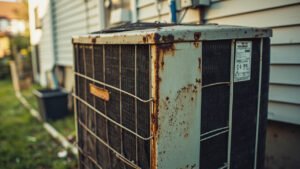
Rust on the furnace cabinet or around the burner compartment indicates moisture is present where it shouldn’t be — possibly from a cracked heat exchanger, a clogged condensate drain, or insufficient combustion air. Soot buildup around the burner assembly (appearing as a black powder rather than normal light dust) suggests incomplete combustion, which may be caused by a dirty burner, incorrect gas pressure, or a cracked heat exchanger allowing room air to mix with the combustion process.
Soot and visible rust around the burner assembly are among the most serious warning signs — both can indicate a cracked heat exchanger, which allows combustion gases (including carbon monoxide) to mix with the air in your home. This requires immediate professional inspection.
Yellow or Flickering Flame
A properly functioning gas furnace burns with a steady blue flame. A yellow flame, an orange flickering flame, or a flame that lifts off the burner port indicates incomplete combustion. Common causes include a dirty air filter, restricted airflow across the heat exchanger, improper gas pressure, or a cracked heat exchanger. A yellow flame produces more carbon monoxide than a blue flame and should be evaluated by a technician.
Inconsistent Room Temperatures
If some rooms in your home are warm while others remain cold despite running the furnace for extended periods, the problem may be duct-related rather than furnace-related — leaky ducts, unbalanced dampers, or closed registers can prevent conditioned air from reaching distant rooms. However, if all rooms are inconsistent simultaneously (the home heats unevenly but the furnace runs continuously), the furnace itself may be struggling to meet load due to a degraded heat exchanger.
Rising Energy Bills Without Usage Changes
A gas furnace loses efficiency as it ages. A unit that was operating at 95% AFUE new may perform at 85–88% AFUE after 10 years due to heat exchanger fouling, burner wear, and degraded insulation. If your gas bill climbs 15–20% or more without a rate increase or changed usage patterns, the furnace is working harder to produce the same heat. An efficiency drop of this magnitude is a clear signal to start budgeting for replacement. For a full rundown of the warning signs to watch for, see our guide to signs a furnace needs replacing.
Heating system costs and heat pumps vs gas heating are covered in their own dedicated guides.
Frequently Asked Questions
How long does a gas furnace last?
A well-maintained gas furnace lasts between 15 and 20 years, with some high-efficiency units reaching 25 years. The lifespan depends on the quality of the unit, how often it cycles, the humidity of the installation environment, and whether annual maintenance is performed. Two-stage and modulating furnaces typically outlast single-stage units because their reduced cycling frequency means less wear per year of operation.
What AFUE rating should I look for?
In most cold and mixed-climate regions, a 90–95% AFUE condensing furnace offers the best balance of upfront cost and long-term operating savings. In milder climates (Zones 6 and warmer), an 80–84% AFUE standard furnace may make economic sense if the heating season is short and the efficiency premium of a condensing unit takes more than 10–12 years to recover through fuel savings.
Is a two-stage furnace worth the extra cost over a single-stage?
Yes — in most cases, the temperature consistency and reduced cycling of a two-stage furnace justify the $500–$1,500 price difference. Two-stage furnaces run longer at low fire during mild weather, which means more even heating, less humidity loss, and fewer drafts. They also typically carry longer warranties and are quieter. The exception is in small homes in mild climates where the furnace may only run a few dozen hours per year — in those cases, the comfort benefit is minimal.
What maintenance does a gas furnace require?
A gas furnace requires an annual professional inspection and cleaning, filter replacements every 1–3 months during heating season, and periodic checks of the flame color and burner condition. Annual service should include combustion analysis (verifying proper gas pressure and combustion efficiency), inspection of the heat exchanger, cleaning or replacement of the flame sensor, and verification of the pressure switch and safety controls. Skipping annual maintenance is the single biggest factor in premature furnace failure.
Can a gas furnace be replaced with a heat pump in the same location?
Yes — air-source heat pumps can typically be installed in the same footprint as a gas furnace, using the existing ductwork. The air handler (the indoor unit that sends air through the ducts) replaces the furnace. This makes for a relatively straightforward conversion in homes with functioning ductwork. A dual-fuel (hybrid) system — pairing a heat pump with a gas furnace — uses the heat pump in mild weather and switches to gas for the coldest days, combining efficiency with reliability.