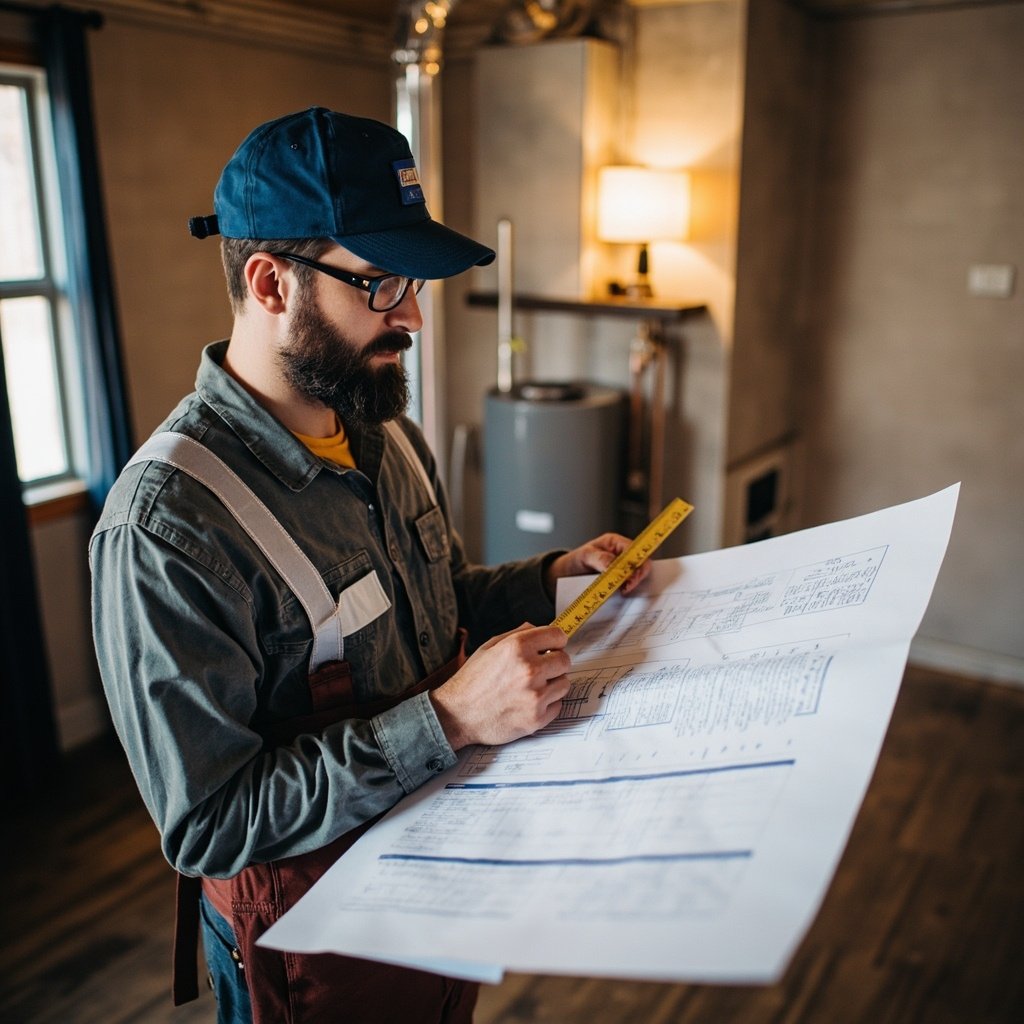
A furnace that is too large cycles on and off constantly, wasting fuel and wearing out components. One that is too small leaves you shivering on the coldest night. Learn about heating system costs → The correct furnace size for your home is determined by a Manual J heat load calculation, which accounts for your home’s square footage, ceiling height, insulation R-values, window specifications, local climate data, and duct leakage — producing a heating capacity requirement measured in BTUh. No furnace should be selected based on square footage alone, despite what many contractors still do.
Why Furnace Sizing Actually Matters
Oversized furnaces cost more to install, waste fuel through short-cycling, and wear out 30–50% faster than correctly sized units — while undersized furnaces run constantly without meeting demand on the coldest days, increasing energy bills without delivering comfort. The installed cost difference between a correctly sized furnace and an oversized unit can be $1,000–$3,000, and the efficiency loss over a 15-year lifespan costs far more in wasted energy.
Short-cycling occurs when a furnace generates heat faster than the home can absorb it. The thermostat reaches the set temperature before the air reaches the far corners of the house, the furnace shuts off, and heat quickly escapes — forcing the furnace to restart within minutes. Each start-stop cycle deposits condensed moisture on the heat exchanger, which over time corrodes the metal. A furnace that short-cycles may last 8–10 years instead of the expected 15–20 years.
An undersized furnace at design temperature (the coldest typical temperature in your area) simply cannot meet the heating demand. It runs continuously, unable to close the gap between outdoor temperature and thermostat setting. This is not just uncomfortable — the furnace works harder, consumes more energy per BTU delivered, and can ice up on the outdoor coil in heat pump configurations.
What Is the Manual J Heat Load Calculation?
The Manual J calculation is the industry-standard method for determining the exact heating and cooling load of a residential building, developed by the Air Conditioning Contractors of America (ACCA). It calculates the total BTUh (British Thermal Units per hour) required to maintain indoor comfort at design conditions — using the home’s specific construction details rather than general rules of thumb.
Inputs the Manual J Calculation Uses
The calculation requires:
- Geographic location — the design temperature for your area (the coldest outdoor temperature that the system must handle, typically the 99th percentile winter temperature)
- Floor area — heated square footage, including all floors
- Ceiling height — affects the volume of air to condition
- Wall construction — material type, thickness, and insulation R-value
- Window specifications — area, type (single/double/triple pane), and U-factor
- Door area and type
- Air infiltration rate — how much outside air leaks into the home
- Internal heat gains — appliances, lighting, occupants
- Duct leakage and location — ducts in conditioned space vs. unconditioned attic/crawlspace
The output is a heating load expressed in BTUh and a cooling load expressed in BTUh.
Design Temperature — The Starting Point
Every Manual J calculation begins with your location’s design temperature — the outdoor temperature used as the basis for equipment sizing. This is not the record low; it is the temperature that the heating system must handle 99% of the time (meaning it only gets colder than this roughly 1% of winter hours).
For example:
- Chicago (Zone 5): Design temperature approximately -4°F
- Minneapolis (Zone 6): Design temperature approximately -13°F
- Atlanta (Zone 3): Design temperature approximately 14°F
- Houston (Zone 2): Design temperature approximately **°F
Using the correct design temperature is critical. A furnace sized for Atlanta conditions will be undersized in Minneapolis, and one sized for Minneapolis will be grossly oversized in Atlanta.
The Step-by-Step Manual J Process
The Manual J process follows these steps: determine design conditions → calculate heat loss through building envelope (walls, windows, doors, ceiling, floor) → calculate infiltration heat loss → sum envelope and infiltration losses → add duct heat gain/loss → determine total heating load. For heat pumps, the cooling load follows a similar but separate process.
Step 1: Define Design Conditions
Set the outdoor design temperature and indoor design temperature target. Indoor comfort is typically assumed to be 68–70°F for heating. The outdoor design temperature comes from ASHRAE climate data for your specific location (available via zip code lookup tools from ACCA or the Sheet Metal and Air Conditioning Contractors’ National Association, SMACNA).
Step 2: Calculate Envelope Heat Loss
Heat flows through any surface from warm to cold. The rate of heat flow depends on:
- The temperature differential between inside and outside
- The area of the surface (square feet)
- The U-factor of the construction assembly (inverse of R-value)
For example, a 200 sq ft wall with a U-factor of 0.08 (R-13 insulation) at a 70°F indoor / 0°F outdoor differential loses:
200 × 0.08 × 70 = 1,120 BTUh through that wall alone.
This calculation is repeated for every wall, window, door, ceiling, floor, and skylight in the building.
Step 3: Calculate Infiltration Heat Loss
Air infiltration accounts for the heat loss from outside air entering the building through cracks, gaps, and mechanical ventilation. The Manual J uses the simplified infiltration method (based on air changes per hour, ACH) or the detailed infiltration model (based on building air leakage testing with a blower door).
In cold climates, infiltration can account for 30–40% of total heating load — a substantial portion that is often underestimated by rule-of-thumb sizing methods.
Step 4: Sum Heat Loss and Add Duct Losses
Add envelope losses and infiltration losses to get the building heat loss. Then add duct losses — the heat lost from air traveling through ducts in unconditioned spaces. Ducts in an unconditioned attic can lose 10–30% of the air’s heat content before it reaches the living space. Learn about proper ductwork installation →
Step 5: Select Furnace Output
The total BTUh calculated is the net heating load — the heat the home loses at design conditions. The furnace selected must have an output capacity at or slightly above this number. A slight oversizing (up to 15%) is acceptable for gas furnaces due to their modulating capability. Heat pumps require more precision because their heating output varies with outdoor temperature.
Furnace Sizing by Home Type — What the Numbers Look Like
For an average American home built to 2000–2010 code standards (R-38 attic insulation, double-pane windows, moderate air sealing), the heating load is approximately 35–50 BTUh per square foot of heated floor area at design temperature. This range narrows for tighter, better-insulated homes and widens for older, poorly insulated homes.
BTUh per Square Foot Examples
These are rough estimates — a Manual J calculation is the only way to get the right number for your specific home.
Common Furnace Sizing Mistakes Homeowners Should Avoid
The most common furnace sizing mistake is using the “40 BTUh per square foot” rule as a final answer — which ignores climate, insulation, ceiling height, windows, and infiltration. Other frequent errors include: selecting the next size up “just in case,” choosing based on the existing furnace size without verifying it was correct, and contractors who upsell by installing a larger furnace than the load requires.
Mistake 1: Selecting Based on Existing Equipment Size
If the old furnace was 100,000 BTUh, homeowners often assume they need 100,000 BTUh again. But if the old furnace was oversized (which is extremely common), you’re repeating the original mistake. Always verify the existing furnace size against a Manual J calculation — never assume the previous installation was correct.
Mistake 2: “One Size Up Just to Be Safe”
Contractors who do not perform a proper Manual J often add 20–30% buffer to whatever number they estimate, and many add an additional size “for safety.” This is how a 60,000 BTUh requirement becomes an 80,000–100,000 BTUh furnace. The safety buffer is not necessary with a proper heat load calculation — and it is actively harmful.
Mistake 3: Ignoring the Heat Pump Capacity Curve
Heat pumps deliver less heat as outdoor temperature drops. A heat pump that produces 60,000 BTUh at 47°F may only produce 36,000 BTUh at 0°F. A heat pump sized for mild-weather capacity will be undersized in cold weather. Heat pump sizing must be based on the heating load at the coldest design temperature, not at the balance point temperature.
How to Get a Proper Manual J Calculation
To get a proper Manual J calculation, hire an HVAC contractor who uses ACCA-approved software (Wrightsoft, RHVAC, or Trace) and asks for detailed information about your home’s construction — not just the square footage. A proper Manual J takes 2–4 hours to complete and produces a multi-page report. Be suspicious of any contractor who quotes furnace size after a 10-minute walk-through without asking about insulation type, window age, or ceiling height.
What to Expect from a Proper Calculation
A legitimate Manual J report includes:
- Design temperatures (indoor and outdoor)
- U-factors and R-values for all building assemblies
- Individual heat loss calculations for each surface type
- Infiltration load calculation
- Duct heat loss/gain calculation
- Total heating and cooling loads in BTUh
- Recommended equipment output (heating) and cooling capacity (in tons)
How Much Does a Manual J Calculation Cost?
A Manual J heat load calculation performed as a standalone service (not bundled with installation) typically costs $300–$600, depending on the contractor and region. Some contractors waive the fee if you sign with them for the installation. Given that a correctly sized furnace saves $1,000–$3,000 upfront and thousands more over its lifespan through efficiency, the calculation cost is a worthwhile investment.
Furnace Sizing FAQ
Can I use an online furnace size calculator?
Online calculators that require only square footage and zip code produce estimates that are accurate to within ±30% at best — which is not sufficient for proper equipment selection. An online calculator that asks about insulation type, window type, ceiling height, number of floors, and orientation is more reliable, but still cannot account for infiltration without blower door testing. Use an online estimate as a starting point; commission a Manual J for the final decision.
Does a bigger furnace always heat a home faster?
No — a furnace that is too large heats the air near the thermostat quickly, causing the furnace to shut off before the rest of the home reaches temperature. The home feels unevenly heated, and the furnace short-cycles, wasting energy and accelerating wear. The right-sized furnace runs long enough to push warm air into the farthest reaches of the home.
What furnace efficiency rating should I choose?
For gas furnaces, choose at minimum a 95% AFUE (annual fuel utilization efficiency) unit if you live in a climate with significant heating demand. High-efficiency furnaces (95–98.5% AFUE) capture most of the heat from combustion and route exhaust gases through a secondary heat exchanger before venting — losing minimal heat up the flue. This matters because even a 5% efficiency difference on a 100,000 BTUh furnace burning 1,000 therms per year equals 50 therms of wasted fuel annually.
Does my existing ductwork size limit what furnace I can install?
Yes — undersized ductwork restricts airflow, which reduces the furnace’s actual heating (and cooling) output regardless of the furnace’s rated capacity. A furnace installed with undersized return or supply ducts will deliver less than its rated BTUh to the living space, similar to a car’s engine running at half capacity due to restricted airflow. Have a Manual D duct design performed before installation to verify ductwork is correctly sized for the selected furnace.
Should a heat pump be sized the same as a gas furnace?
Heat pump sizing follows the same Manual J principles as gas furnaces, but with one critical difference: heat pump heating output varies with outdoor temperature. A heat pump is typically sized to meet 100% of the heating load at the balance point temperature (the outdoor temperature where the heat pump’s output equals the home’s heat loss), with supplemental or backup heat covering the coldest hours. The result is often a smaller-capacity heat pump than would be selected as a gas furnace for the same home.