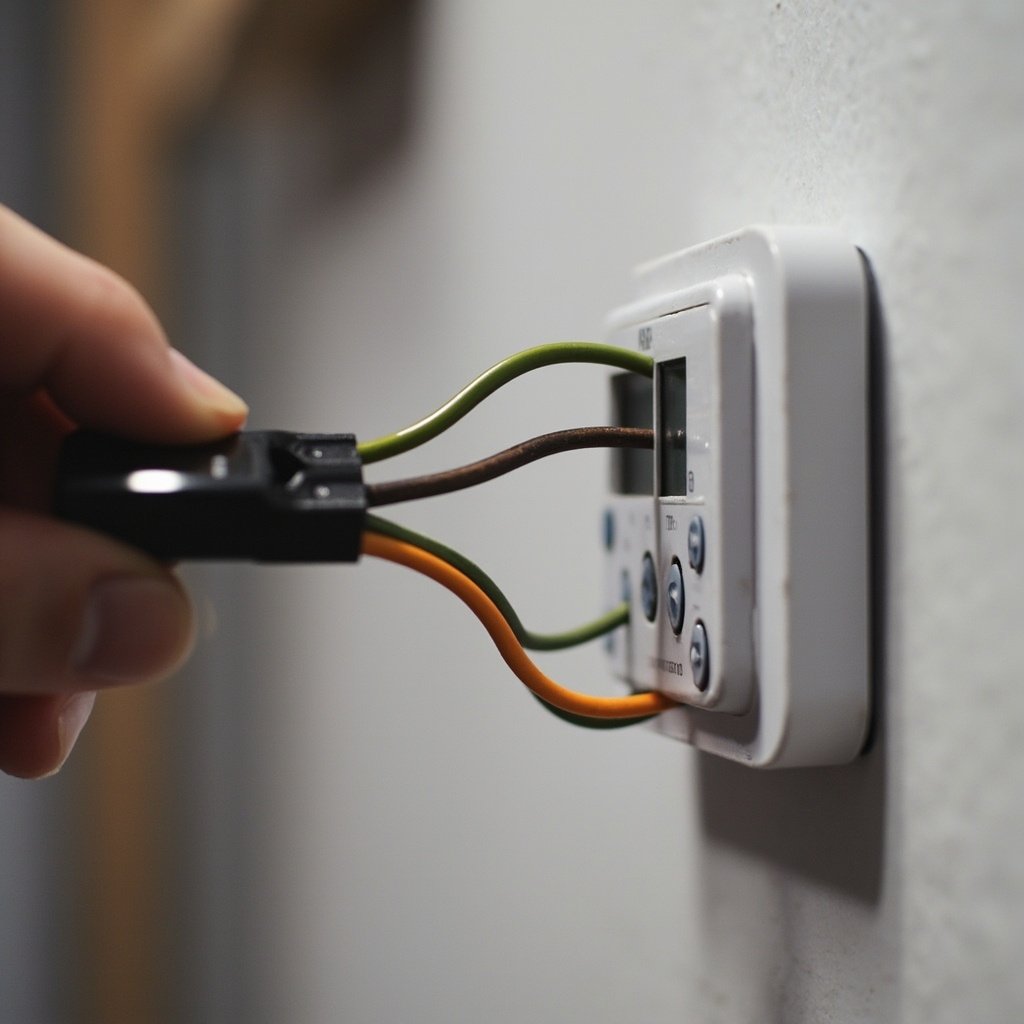
HVAC thermostat wiring confuses most homeowners — the label on the thermostat base, the wire color chart, and the control board schematic all say different things. Learn about smart thermostat options → Thermostat wiring follows a standardized color code in North America: R (red) is 24V power, W (white) calls for heat, Y (yellow) calls for cooling, G (green) runs the fan, C (common) completes the 24V circuit, and O/B (orange/blue) control the heat pump reversing valve. Each letter represents a circuit — and the thermostat simply connects the R terminal to the appropriate control terminals to signal the HVAC equipment what to do.
What the Letters on Your Thermostat Actually Mean
The letter terminals on a thermostat represent individual control circuits — when a thermostat connects R (24V power) to W, it signals the furnace to produce heat; connecting R to Y calls for cooling; connecting R to G runs the indoor fan. The letters are standardized across nearly all residential HVAC equipment regardless of brand, though heat pumps and multi-stage systems add additional letters.
The Core Terminals
The thermostat’s job is simple: connect R to any terminal that needs to be activated. When you raise the thermostat temperature setting in heating mode, the thermostat internally connects R to W (and possibly to E or AUX if it’s a heat pump). When you lower it, those connections open.
The Wiring Diagram on the Thermostat Base
The wiring diagram on the thermostat mounting base is the master reference for your specific installation — it shows exactly which terminals are used, which wires go where, and whether jumpers or accessories (like outdoor temperature sensors, humidifiers, or zoning panels) are present. Always photograph the existing wiring before removing the thermostat.
Reading the Terminal Layout
A typical thermostat base has screw terminals arranged in two rows — commonly called the RCYGW arrangement or the expanded layout depending on system complexity. The labels printed on the base tell you:
- Which terminals accept wires (the screws you push or wrap wire under)
- Whether any terminals are bridged by a factory-installed jumper (e.g., Rh connected to Rc)
- Whether there are accessory terminals for things like a dehumidifier, ERV, or outdoor reset
The Factory Jumper
Many thermostats ship with a jumper (a small metal piece) connecting the Rh and Rc terminals. This is because most homes have a single transformer that powers both heating and cooling through the same R wire. When you see a jumper in place, it means both the heating and cooling transformers share the same 24V power supply.
In homes with separate heating and cooling transformers (older dual-transformer systems), the jumper is removed and the Rh terminal connects to the heating transformer while Rc connects to the cooling transformer. Never connect Rh and Rc together in a dual-transformer system — doing so causes the heating transformer to backfeed into the cooling transformer, potentially damaging components.
Optional Terminals
- C terminal (Common): The return wire for 24V power. Newer “smart” thermostats (Nest, ecobee, Honeywell T6) require a C wire because they draw constant power for their displays and wireless radios. If you do not have a C wire and your smart thermostat requires one, you may need to run a new 18-gauge wire from the control board to the thermostat, or use a common wire adapter.
- O/B terminal: Controls the heat pump reversing valve. In most Carrier, Trane, and Lennox heat pumps, O means “reversing valve energizes in cooling mode.” In some Mitsubishi and Fujitsu units, B means “reversing valve energizes in heating mode.” Check your heat pump’s documentation — mixing O and B is one of the most common heat pump thermostat wiring errors.
- L terminal: A fault indicator wire. When the HVAC system detects a fault, it sends 24V through the L wire to illuminate a light on the thermostat. Not all thermostats use this wire.
- E terminal: Emergency heat call wire on heat pump systems. When E is energized, the heat pump shuts off and only the electric resistance strips (emergency heat) run. Learn about emergency heat mode →
Reading the HVAC Equipment Control Board
The furnace or air handler control board has its own terminal block where the thermostat wires connect — and the diagram printed on the board or in the equipment manual shows which terminal does what. The control board is the actual decision-maker; the thermostat simply sends signals.
Furnace Control Board Terminals
A standard furnace control board typically has these terminals:
- R: 24V power input from thermostat
- W: Heat demand signal input — when R and W are connected, the control board energizes the gas valve and ignition sequence
- G: Fan demand signal input — energizes the indoor blower motor
- Y: Cooling demand signal input — energizes the contactor in the outdoor AC unit (via the Y wire through the thermostat)
- C: 24V common — completes the power circuit
The control board also has terminals that send power OUT to accessories:
- V (or X): 24V accessory power (for humidifiers, dehumidifiers, zone panels)
- H (or W2): Second-stage heat or humidifier control
- O (or Y2): Second-stage cooling
Heat Pump Control Board Terminals
A heat pump control board adds heat pump specific terminals:
- O/B: Reversing valve control
- E: Emergency heat
- X (or W2): Auxiliary heat / second-stage heat
- L: Fault indicator output
Color Code Conventions
The wire colors at the equipment are generally consistent with the thermostat terminal colors, but there are exceptions. When replacing a thermostat, rely on the terminal labels, not the wire colors — wire colors can be misleading if previous installers used the wrong colors or splice locations exist.
Standard wire color usage:
- Red: R (power)
- White: W (heat)
- Yellow: Y (cooling)
- Green: G (fan)
- Blue: C (common) — though some installers use blue for O/B instead
- Orange: O (reversing valve in some systems)
- Brown: E or Y2 (second stage heat or cool)
- Black: W2 or X (auxiliary heat)
Common Thermostat Wiring Configurations
Standard Gas Furnace with AC
The simplest configuration:
- R → Furnace board R
- C → Furnace board C (if present)
- W → Furnace board W
- Y → Furnace board Y (triggers AC contactor)
- G → Furnace board G
The Y wire runs to the outdoor AC unit, not the furnace — but when the thermostat calls for cooling and connects R to Y, the signal travels from the thermostat to the furnace board via the Y wire, and the furnace board relays that signal (via a separate wire) to the AC contactor.
Heat Pump with Gas Furnace Backup (Dual-Fuel)
For a heat pump paired with a gas furnace (dual-fuel system):
- R → Heat pump control board R
- C → Heat pump control board C
- W → Gas furnace control board W (for gas heat, not called by heat pump thermostat)
- Y → Heat pump compressor
- G → Fan
- O → Reversing valve
- E → Emergency heat (electric strip heat on heat pump)
- W2 → Gas furnace heat (second stage / aux heat when heat pump can’t keep up)
In dual-fuel systems, the thermostat typically has two heat settings: “Heat” (which runs the heat pump) and “Emergency Heat” (which disables the heat pump and runs the gas furnace directly).
Multi-Stage Systems
For systems with two-stage furnaces or air conditioners:
- W2 or H: Second-stage heat
- Y2 or O: Second-stage cooling
- G: Fan
- The thermostat has extra terminals for the second-stage wires, and the equipment control board has corresponding second-stage terminals
How to Troubleshoot Thermostat Wiring Problems
Troubleshoot thermostat wiring by verifying 24V power at the R and C terminals with a multimeter, checking for voltage at each control terminal when the corresponding function is called, and checking wire continuity at the equipment end if the thermostat signal does not reach the control board. Most thermostat wiring problems fall into three categories: a disconnected wire, a broken wire in the wall, or a failed control board.
Step 1: Measure Voltage at the Thermostat
Set a multimeter to AC volts (24V scale). With the thermostat calling for heat (or just verify at the R-C pair):
- R to C: Should read approximately 24–28V AC — no reading means the C wire is not connected, the transformer is dead, or the power is off
- R to W: With a heat call active, should read approximately 24V — no reading means the thermostat is not sending the signal or the W wire is broken
Step 2: Verify Wire Continuity
If R to C shows 24V at the thermostat but the equipment does not respond, the problem is in the wiring between the thermostat and the equipment. At the equipment control board:
- Measure R to W at the board — if 24V is present at the board but the furnace doesn’t respond, the control board is likely failed
- If 24V is not present at the board with a heat call active, the wire between thermostat and board has an open circuit
Step 3: Check for Common Wire Problems
Smart thermostat installations that lose power, display “no power” warnings, or randomly reboot typically have a C wire problem — the C wire either isn’t connected at the equipment end, or there is a voltage drop along the C wire path. Use a multimeter to check the voltage between R and C at the equipment board. If it reads below 22V, the common connection is poor or the transformer is overloaded.
Thermostat Wiring FAQ
Can I use a 4-wire thermostat on a heat pump?
A standard 4-wire thermostat (R, W, Y, G) does not have enough wires to control a heat pump, which additionally requires O/B (reversing valve), E or W2 (emergency/auxiliary heat), and ideally C (common). A minimum of 5 wires is needed for most heat pump installations (R, C, Y, G, O/B), with 7 or 8 wires required for dual-fuel systems with second-stage heating and auxiliary heat.
Why does my thermostat have two R terminals (Rh and Rc)?
Two R terminals indicate a dual-transformer system — one transformer powers heating (Rh) and another powers cooling (Rc). A factory-installed jumper between Rh and Rc combines them into a single power source when only one transformer is present. If you have separate transformers, remove the jumper. Connecting both transformers together without the jumper can cause equipment damage.
What happens if I wire the O and B terminals backwards on a heat pump?
If the O/B terminal is wired backwards, the heat pump’s reversing valve will energize in the wrong mode — the unit will cool when you call for heat, and heat when you call for cooling. This is a common installation error. Check your heat pump’s documentation to determine whether your unit uses O (reversing valve energizes in cooling) or B (reversing valve energizes in heating) — the wrong selection will produce no heating or cooling in the respective mode.
Do smart thermostats work without a C wire?
Many smart thermostats (Nest Learning Thermostat, ecobee, Honeywell Home T9) include a power management feature that draws intermittent power from the W wire to charge an internal battery — allowing installation without a C wire in most cases. However, the C wire is the cleaner solution and prevents battery-related reliability issues. If you experience random power losses or thermostat reboots on a smart thermostat without a C wire, running a new 18-gauge wire for the C connection is the recommended fix.
My thermostat wiring looks like a mess — how do I decode it?
The key is to systematically identify each wire at both ends. Turn off the HVAC power at the breaker, remove the thermostat cover, photograph the terminal arrangement, then disconnect one wire at a time, noting its terminal. At the equipment end (furnace/air handler), match the wire colors to the terminal labels on the control board. Work methodically — thermostat wiring follows simple conventions, and a methodical approach always reveals the correct configuration.