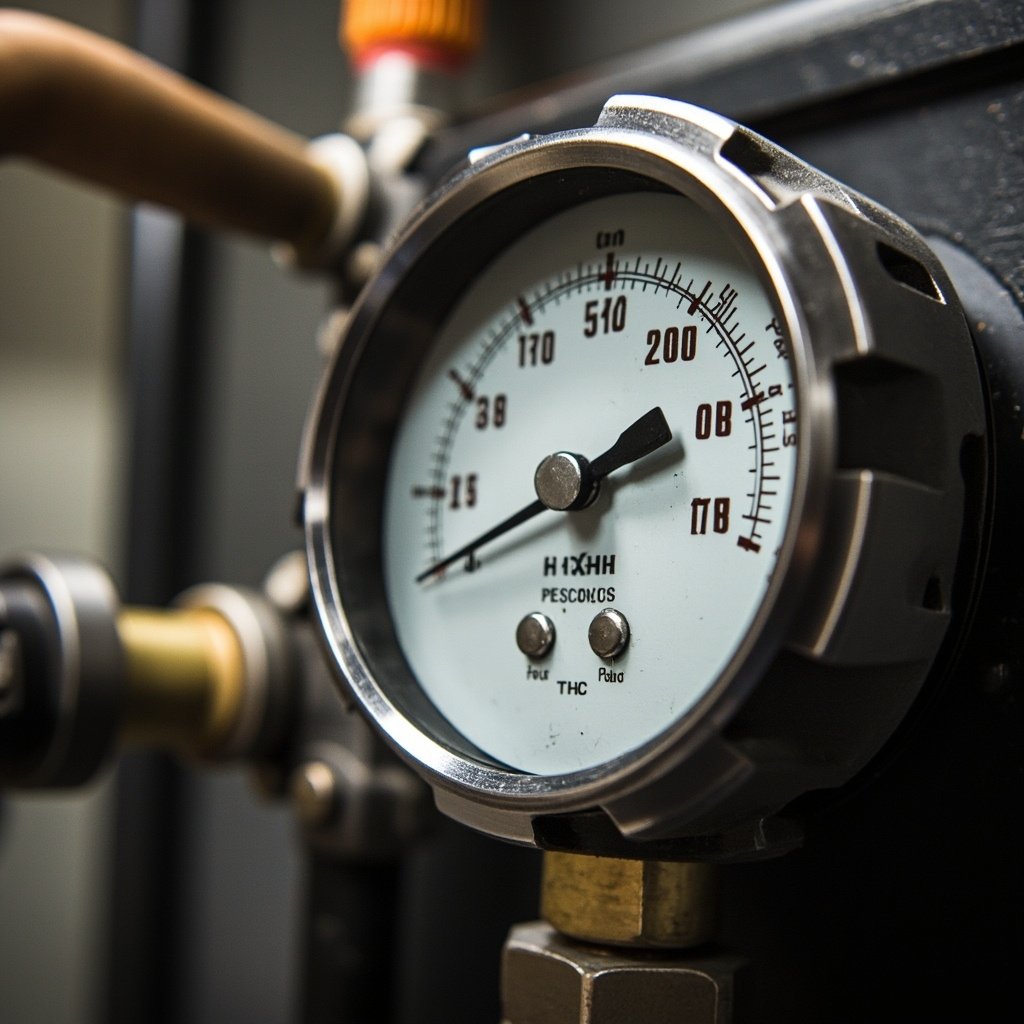
Boiler pressure problems are among the most common service calls for heating professionals, and most have straightforward causes and fixes. Learn how boilers work → Pressure in a sealed hydronic boiler system should remain between 1 and 2 bar on the pressure gauge during normal operation — pressure below 1 bar indicates water loss from the system, and pressure above 3 bar triggers the pressure relief valve to discharge. A boiler running at the correct pressure produces heat efficiently and maintains a sealed, stable system; pressure that rises or falls outside the normal range signals a leak, a failed component, or a system imbalance.
Understanding Your Boiler’s Pressure Gauge
The pressure gauge on a boiler displays the pressure of the water inside the sealed hydronic system, measured in bar (European standard) or PSI (U.S. standard — 1 bar = 14.5 PSI). Most residential boiler gauges have a display range of 0–4 bar or 0–60 PSI, with a green zone typically marked between 1–2 bar. During normal operation, the needle should sit in the green zone when the system is cold and rise slightly (but not exceed 2.5 bar) when the system is hot.
Normal Pressure Range
The difference between cold and hot pressure is called thermal expansion — when water heats from 50°F to 180°F, it expands by approximately 3–4% of its volume. This is why a properly pressurized system shows a higher reading when hot versus cold.
The Green Zone Explained
The green zone (typically 1–2 bar) represents the pressure range where the system has enough water to circulate properly and the pump can maintain positive pressure at the highest point in the system (usually the top floor radiator). Below the green zone, the pump may cavitate or air may enter the system. Above the green zone, the pressure relief valve activates.
Why Your Boiler Pressure Is Dropping
Boiler pressure drops when water escapes the sealed system through a leak, a weeping valve, an overflow pipe that is discharging water, or evaporation through an auto-fill valve that is failing to close properly. The most common cause of gradual pressure loss over weeks or months is a slow leak somewhere in the system — in a pipe joint, radiator valve, the heat exchanger, or the boiler itself.
Cause 1: System Water Loss Through a Leak
The most serious cause of pressure loss is a leak in the system piping. Water escapes and pressure drops accordingly. Small leaks may not be visible — a pinhole in a floor joist space or behind a wall may only manifest as a pressure drop of 0.2–0.5 bar per week. Large leaks will cause rapid pressure loss and may be accompanied by visible water pooling under the boiler or along pipe runs.
How to locate a pressure loss leak:
- Check all visible pipe joints, radiator valves, and pipe unions for weeping or dripping
- Inspect the pressure relief valve (PRV) discharge pipe — if it is wet or dripping, the PRV may be discharging due to high pressure OR it may be weeping internally
- Look for water stains on ceilings below bathrooms or radiators
- Check the boiler’s internal components (visible through service panels) for water accumulation
- Mark the pressure gauge and monitor it over 24 hours — if it drops more than 0.3 bar in a day, there is a significant leak somewhere
Cause 2: Expansion Vessel Failure
The expansion vessel (also called an expansion tank or bladder tank) is a sealed vessel with a compressible air bladder inside. When system water heats and expands, the expansion vessel absorbs the extra volume, preventing pressure from building to dangerous levels. The vessel is pre-charged with air at the factory (typically 0.8–1.0 bar) and connected to the system water on one side.
If the bladder inside the expansion vessel fails (ruptures), water enters the vessel and the compressible air volume disappears. With no place to absorb thermal expansion, system pressure rises rapidly when the boiler heats — potentially triggering the PRV. Then, when the system cools, the pressure drops below normal because the water that entered the vessel during heating is now not returned properly.
A failed expansion vessel causes a pattern of pressure that rises too high when hot and drops too low when cold. This is a very common boiler problem in systems older than 10 years. Learn about annual boiler maintenance →
Cause 3: Auto-Fill Valve Failure
Many modern boiler systems have an auto-fill valve (also called a fill valve or pressure reducing valve) that connects to the domestic water supply and automatically adds water to the heating system if pressure drops below the setpoint. This valve is set to maintain a constant system pressure (e.g., 1.2 bar).
If the auto-fill valve fails to close — because the diaphragm is worn or a washer is damaged — it continuously adds water to the system. This causes pressure to rise continuously, potentially activating the PRV. Conversely, if the valve is set too low or partially clogged, it may not add water fast enough to maintain pressure during a slow leak.
Cause 4: Radiator Air Buildup
Air trapped in radiators does not directly cause pressure loss, but it reduces system efficiency and can mask pressure problems. Trapped air occupies space in the system that water should fill, which may cause the pressure gauge to read slightly lower than it should. Bleeding radiators releases this air and allows the system to fill with water properly.
Repressurizing a Boiler (When It’s Safe to Do So)
If your boiler pressure is slightly low (above 0.5 bar) and you have verified there is no active leak, you can repressurize using the filling loop:
- Ensure the boiler is cold (not actively heating)
- Identify the filling loop — a braided hose connecting the domestic water supply to the heating system, with two valves and a central check valve
- Open the valves slowly (one quarter turn at a time) to allow cold water into the system
- Watch the pressure gauge — stop when it reaches 1.2–1.5 bar
- Close the valves and verify the pressure holds
Do not repressurize a boiler if you can see active water leakage — adding water will worsen the leak and increase water damage. In that case, shut the system down and call an HVAC professional.
Why Your Boiler Pressure Is Rising Too High
Boiler pressure rises when the expansion vessel cannot absorb thermal expansion — typically because the vessel’s bladder has failed, the vessel is waterlogged, or the system is overfilled beyond what the vessel can accommodate. High pressure triggers the pressure relief valve (PRV) to discharge water, which is the safety mechanism preventing dangerous over-pressure in a sealed system.
Cause 1: Failed Expansion Vessel (Waterlogged)
When an expansion vessel fails, it fills with water and loses its compressible air cushion. With no room for thermal expansion, pressure rises rapidly every time the boiler fires. The pressure relief valve discharges to prevent dangerous over-pressure, and the pressure drops when the system cools — but rises again on the next heating cycle.
Diagnosing a waterlogged expansion vessel:
- Isolate the expansion vessel from the system (shut the valve on the vessel’s system connection)
- Use a tire pressure gauge or dedicated expansion vessel tester to check the air-side pressure of the vessel
- If the vessel shows pressure equal to or higher than the system pressure (no differential), the bladder is failed
- Replace the expansion vessel — never bleed the vessel to reduce pressure, as this removes the pre-charge needed for it to function
Cause 2: Overfilled System
If the system is overfilled (too much water), the expansion vessel cannot accommodate all the thermal expansion, and pressure builds. This typically occurs when someone repressurizes without bleeding radiators first — adding water increases the total system volume beyond what the expansion vessel can handle.
Draining water from the system to reduce pressure:
- Connect a hose to the drain valve at the lowest point of the system (usually near the boiler)
- Open a vent on a high radiator to allow air to enter
- Open the drain valve and allow water to exit until pressure drops to 1.0–1.5 bar on the cold gauge
- Close the drain valve and refill as needed
Cause 3: Faulty Pressure Relief Valve (PRV)
The pressure relief valve is a mechanical safety device. If it fails to seat properly, it may weep continuously — a small drip from the discharge pipe. This can look like high pressure even when the system pressure is normal, because the valve’s spring-loaded seat is not sealing properly.
A leaking PRV should be replaced immediately — it is the boiler’s last line of defense against dangerous over-pressure, and a failed PRV means the system has no safety release. Replacement typically costs $150–$350 in parts and labour.
Cause 4: Blocked Expansion Pipe
The expansion pipe (sometimes called the charge pipe) connects the boiler to the expansion vessel. If this pipe is blocked (by debris, a closed valve, or frost), the expansion vessel cannot function and pressure rises. Check that the isolation valve on the expansion vessel is fully open.
The Relationship Between Pressure Relief Valve and System Safety
The pressure relief valve (PRV) is a non-adjustable safety device set to open at approximately 3 bar (43.5 PSI) — any pressure above this is dangerous and the valve must discharge water to protect the system. If your PRV is discharging water, the system pressure is at or above 3 bar, which is an emergency condition. Shut the system down, allow it to cool, investigate the cause, and do not operate the boiler until the pressure problem is resolved.
PRVs are tested and calibrated at the factory — they cannot be adjusted in the field. If it is discharging, either the system is severely over-pressurized (caused by overfilling or expansion vessel failure) or the PRV itself is faulty and must be replaced. Never plug or cap the PRV discharge pipe — water must be able to escape to prevent catastrophic over-pressure.
How to Monitor and Maintain Healthy Boiler Pressure
Monitor boiler pressure weekly by checking the gauge, noting whether the reading is in the green zone, and watching for gradual trends up or down. Maintenance that prevents pressure problems includes: annual expansion vessel inspection (checking the air pre-charge with a dedicated tester), repressurizing through the filling loop only when the system is cold, keeping the PRV discharge pipe unobstructed, and checking for weeping at any valve or joint in the system during annual service.
Pressure Log Example
A simple pressure log like this takes 30 seconds per week and reveals pressure problems months before they become emergencies.
Boiler Pressure FAQ
Is it normal for boiler pressure to fluctuate?
Yes — pressure rises when the boiler heats (water expands) and falls when it cools (water contracts). A fluctuation of 0.3–0.5 bar between cold and hot readings is normal. Pressure that rises above 2.5 bar when hot is not normal. Pressure that drops below 0.5 bar at any time is not normal.
Can I add water to my boiler while it is running?
You should not add water to a hot boiler — the temperature differential between cold make-up water and a hot heat exchanger can cause thermal shock and crack the heat exchanger. Let the boiler cool to room temperature before repressurizing. If you must add water urgently (in freezing conditions when the system is at risk of freezing), add it very slowly while the boiler is running at low temperature to minimize the thermal shock.
What pressure should my boiler be at when the heating is on?
When a boiler is actively heating, pressure typically reads 1.5–2.0 bar — the hot water expansion has pushed the reading upward from the cold reading. If the pressure climbs above 2.5 bar during normal heating, there is a problem with the expansion vessel or the system is overfilled. If it climbs to 3.0 bar, the PRV will activate.
Why does my boiler lose pressure only in summer?
Summer pressure loss is typically from a leak that only shows up when the system is cold and contracting — microscopic leaks that are sealed by thermal expansion when the system is hot become visible when the system cools. If your boiler loses pressure in summer (when not heating) but seems stable in winter, you have a slow leak in the system that needs professional repair.
Can a faulty thermostat cause pressure problems?
No — a faulty thermostat may call for heat at the wrong times, but it does not affect system pressure. Pressure problems are always related to water volume, expansion vessel function, or valve failures in the sealed hydronic system.