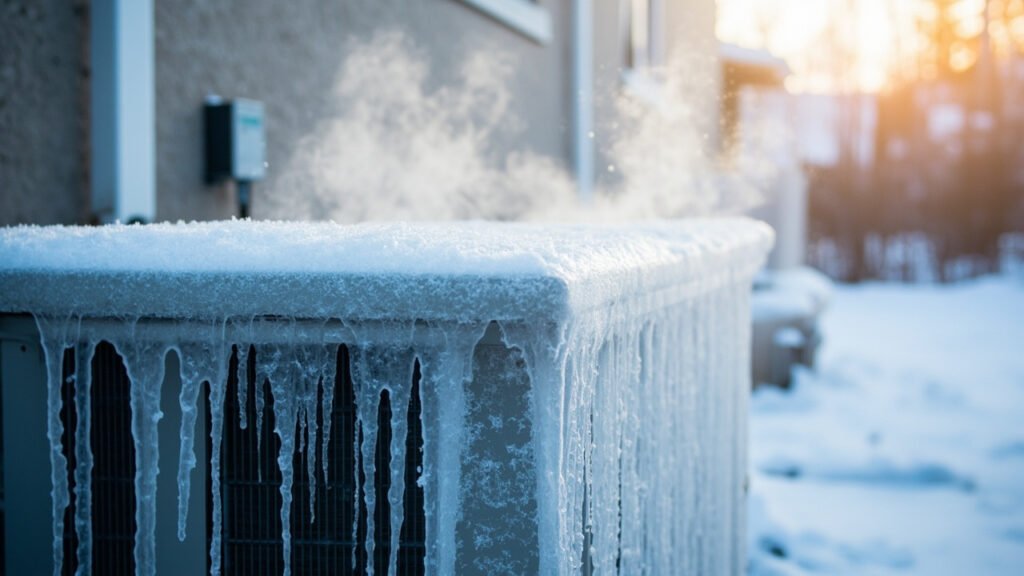
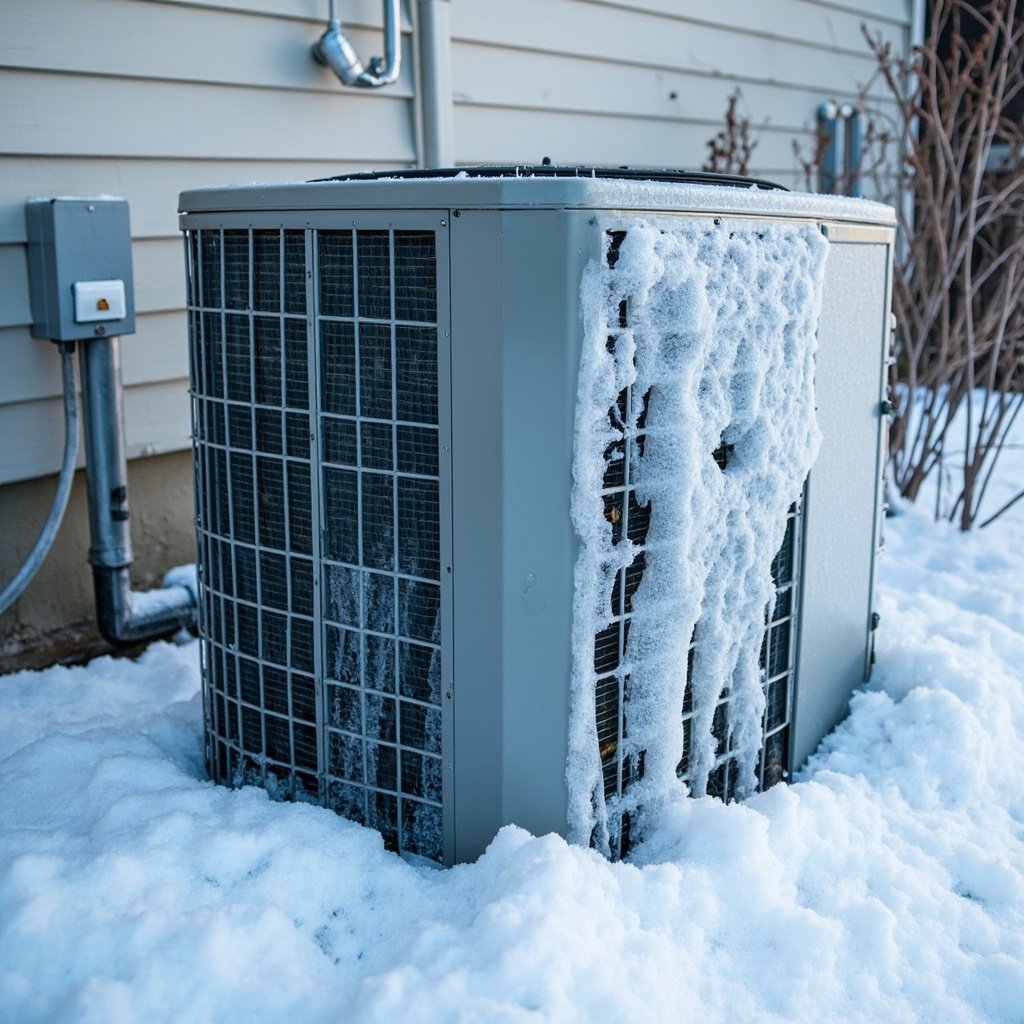
When outdoor temperatures hover near freezing and humidity is present, frost accumulates on the outdoor coil of a heat pump — which is normal and expected. Learn how heat pumps work → The defrost cycle is a brief, automatic reversal of the refrigeration cycle that sends warm refrigerant to the outdoor coil, melting accumulated frost and restoring heat transfer efficiency. A properly functioning defrost cycle typically runs for 4–10 minutes every 30–90 minutes in frost-prone conditions. If your heat pump is not defrosting properly, ice builds up on the coil, heating efficiency drops sharply, and in severe cases the unit shuts down completely.
Why Frost Forms on a Heat Pump Outdoor Coil
Frost forms on the outdoor coil because the coil’s surface temperature drops below the dew point of outdoor air when the heat pump is operating in heating mode — which happens every time the refrigeration cycle extracts heat from outdoor air. The coil temperature in heating mode can fall to 28–35°F during operation, which is cold enough for moisture in the outdoor air to freeze on contact with the metal coil fins.
Frost accumulation is most aggressive in three conditions:
- Outdoor temperatures between 30–40°F — the “wet cold” zone where humidity is high but temperatures hover right around freezing
- High relative humidity — damp air deposits more moisture on cold surfaces than dry air
- Low heat pump efficiency — when the coil temperature differential is greatest (older units, dirty coils, low refrigerant charge)
A thin, even layer of frost on the coil is normal. The problem develops when frost accumulates faster than it can melt — the defrost cycle is designed to handle exactly this situation.
How the Heat Pump Defrost Cycle Works
The heat pump defrost cycle works by reversing refrigerant flow, sending warm refrigerant to the outdoor coil to melt ice, while the indoor blower may briefly pause or run on low heat to prevent cold air from being blown into the home. Most modern heat pumps use one of two defrost methods: a time-temperature method (which defrosts on a fixed schedule) or a demand defrost method (which monitors coil temperature and pressure to defrost only when frost is actually present).
Reverse Valve Defrost
The defrost cycle begins when the heat pump’s control board sends a signal to the reversing valve — the same valve used to switch between heating and cooling modes. The valve repositions to redirect warm refrigerant toward the outdoor coil instead of the indoor coil.
During defrost:
- The outdoor fan stops (to conserve heat on the coil)
- The reversing valve repositions to send hot refrigerant to the outdoor coil
- Hot refrigerant (typically 60–80°F) flows through the outdoor coil
- The ice melts and drips off the coil fins and base pan
- The control board monitors coil temperature via sensors; when the coil reaches roughly 50–57°F, defrost ends
- The reversing valve returns to heating position and the outdoor fan restarts
The total defrost cycle lasts 4–10 minutes. During this time, you may feel slightly cooler air coming from your indoor vents — this is normal and expected. Some systems use electric resistance strips to supplement indoor heat during defrost.
Demand Defrost vs. Time-Temperature Defrost
Time-temperature defrost initiates a defrost cycle at preset intervals (e.g., every 30, 60, or 90 minutes of compressor run time) regardless of actual frost accumulation. This method is simple but wastes energy in mild conditions when no frost is present.
Demand defrost uses temperature sensors on the coil and sometimes refrigerant pressure transducers to detect when frost is actually accumulating. The control board initiates defrost only when the coil temperature drops below a threshold or when the temperature difference between two sensors indicates frost buildup. Demand defrost is 15–30% more efficient than time-temperature defrost because it only runs when necessary.
Most modern heat pumps from major manufacturers (Carrier, Trane, Lennox, Mitsubishi, Fujitsu) use demand defrost. If your heat pump is more than 15 years old, it likely uses time-temperature defrost.
Signs Your Heat Pump Defrost Cycle Is Not Working
Your heat pump defrost cycle is not working properly when you see ice encasing the outdoor coil and fan housing, when the unit runs but produces no heat, when the home feels cold despite the thermostat being satisfied, or when the heat pump short-cycles and the defrost indicator light is illuminated. Ice buildup that persists after a defrost cycle should complete — or ice that reforms within hours of a defrost — indicates a problem with the defrost controls.
Ice Accumulation on the Coil
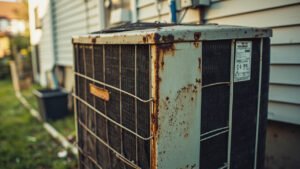
A light, even frost layer that melts within minutes is normal. Ice that coats the entire coil, builds up on the fan housing, or forms thick slabs across the fins indicates the defrost cycle is not activating or not completing.
Heat Pump Running but Not Heating
If the outdoor unit appears to be running (compressor is humming) but the home is not warming up, ice on the coil may be blocking airflow across the heat exchanger. The heat pump can still compress refrigerant, but it cannot transfer heat effectively when the coil is insulated by ice.
Frequent Short-Cycling
When ice blankets the coil, the refrigeration cycle becomes increasingly inefficient — the heat pump works harder to achieve less heating, hits the thermostat setpoint with difficulty, and shuts off. This short-cycling pattern is a telltale sign of a defrost problem.
Fault Codes on the Thermostat or Outdoor Unit
Most modern heat pump outdoor units display fault or status codes via LED lights. A blinking light pattern (e.g., “3 flashes, pause, repeat”) often indicates a defrost sensor fault, reversing valve problem, or defrost board failure. Learn about heat pump troubleshooting →
Common Defrost Cycle Problems and What Causes Them
The most common defrost cycle problems are failed defrost thermostats or sensors, a faulty reversing valve, a malfunctioning defrost control board, low refrigerant charge reducing coil temperatures, and power issues to the outdoor unit that prevent the defrost cycle from initiating. Each has distinct symptoms that help narrow the diagnosis.
Failed Defrost Thermostat or Sensor
The defrost thermostat (also called the defrost sensor or temperature sensor) sits against the outdoor coil and tells the control board when the coil is cold enough to require defrosting — and when it is warm enough to end the defrost cycle. If the sensor fails open or shorted, the board may never initiate defrost, or defrost may never end (causing the unit to defrost constantly in mild weather).
A failed defrost thermostat typically costs $25–$75 for the part and $150–$300 for labour to diagnose and replace.
Reversing Valve Failure
The reversing valve is a solenoid-operated valve that redirects refrigerant flow between heating and cooling modes. In defrost, the valve must reposition to send hot refrigerant to the outdoor coil. If the valve is stuck or the solenoid has failed, the defrost cycle cannot initiate — or refrigerant may not flow properly during defrost.
Reversing valve problems often require a professional with refrigerant handling certification to diagnose and repair. A reversing valve replacement including labour and refrigerant recharge typically costs $400–$900.
Faulty Defrost Control Board
The defrost control board (or defrost board) is the brain of the defrost cycle — it receives input from the defrost thermostat or sensors, processes the demand, and sends signals to the reversing valve and outdoor fan. A failed board may not send the defrost signal at all, may send it at the wrong times, or may fail mid-cycle.
Defrost board replacement typically costs $150–$350 in parts and $200–$400 in labour.
Low Refrigerant Charge
Low refrigerant reduces the heat-carrying capacity of the system and causes the coil temperature to drop further — accelerating frost accumulation beyond what the defrost cycle can handle. If your heat pump’s defrost problems appeared suddenly and are accompanied by higher energy bills and reduced heating output, have the refrigerant charge checked. Learn about heat pump efficiency in cold climates →
A refrigerant leak causing low charge must be repaired before the system is recharged. Common leak points include the service valve ports, coil connections, and copper line sets.
What to Do If Your Heat Pump Is Frozen
If your heat pump outdoor coil is frozen, first verify the defrost cycle is operating (listen for the reversing valve click, watch for the outdoor fan to stop briefly, and check the thermostat for a defrost indicator) — then wait 10 minutes for the defrost to complete. If the unit is not defrosting, switch the thermostat to emergency heat mode to maintain indoor heating and contact an HVAC technician.
Immediate Steps
- Switch to emergency heat on the thermostat to maintain indoor heating — this prevents the home from cooling while you address the outdoor unit
- Check the outdoor unit — look for obvious ice buildup, snow coverage around the base, or any visible damage to the coil
- Clear snow and debris from around and on top of the outdoor unit — ice can form from dripping meltwater refreezing in cold temperatures
- Do not attempt to chip ice off the coil fins — this damages the delicate aluminum fins and can puncture refrigerant lines
When to Call a Technician
Call an HVAC technician if:
- Ice persists after the unit has been running in mild outdoor temperatures (above 40°F) for more than 2 hours
- The defrost cycle runs but ice returns within 24–48 hours — indicating a stuck or failed defrost thermostat
- The outdoor unit makes unusual sounds during defrost (grinding, hissing) — indicating mechanical failure
- You see water pooling inside the home near the air handler — indicating a refrigerant leak inside the conditioned space
Preventing Defrost Problems
Prevent defrost problems through annual heat pump maintenance before winter, keeping the outdoor unit clear of snow and vegetation, ensuring proper drainage from the base pan, and verifying the defrost cycle operates correctly during the first cold snap of the season. A heat pump that defrosts properly once each winter is far less likely to ice up severely than one that has been neglected.
Annual Pre-Winter Maintenance Checklist
- Clean the outdoor coil — rinse with a garden hose to remove dirt, debris, and leaves that restrict airflow and accelerate frost accumulation
- Test the defrost cycle — set the thermostat to cooling mode briefly to force the unit into cooling (reverse) mode, then switch back — observe whether the outdoor fan stops and restarts as expected
- Check the base pan drain — clear any debris blocking the drain hole in the base pan; a blocked drain causes water to back up and freeze on the coil
- Verify defrost thermostat operation — during cold weather, the defrost thermostat should close (call for defrost) when its temperature drops below approximately 37°F
- Check reversing valve operation — listen for the valve to click when the mode changes
Heat Pump Defrost FAQ
How often should a heat pump go into defrost mode?
In frost-prone conditions, a heat pump with demand defrost typically initiates defrost every 30–90 minutes of heating run time, depending on how quickly frost accumulates. Time-temperature defrost units may defrost on a fixed schedule regardless of actual frost presence. The defrost cycle itself runs for 4–10 minutes. If your heat pump is not defrosting at all on a cold, damp day, the defrost system needs inspection.
Why does my heat pump blow cold air during defrost?
During the defrost cycle, the heat pump reverses to send warm refrigerant to the outdoor coil, which means the indoor coil becomes cold — the refrigeration cycle is temporarily in “cooling mode” even though the thermostat is calling for heat. Most heat pumps mitigate this by briefly pausing the indoor blower during defrost, using electric resistance strips to add heat, or running the blower at low speed. You may feel slightly cool air for 1–3 minutes during defrost — this is normal and expected.
Can I manually defrost my heat pump?
Most modern heat pumps have a test defrost mode accessible via a button on the outdoor unit or through the thermostat in some cases. Check your owner’s manual. To manually force a defrost cycle, set the thermostat to cooling mode for 30 seconds (which reverses the unit), then switch back to heating. This forces a defrost cycle. On older units without a test mode, a technician can jump the defrost board to initiate defrost manually.
Does snow on the heat pump mean it is not defrosting?
Light snowfall that melts on contact with a running heat pump outdoor coil is normal. Snow that accumulates on top of the unit and doesn’t melt indicates the coil temperature is below freezing and the defrost cycle is either not running or not melting the accumulation. After a snowfall, clear snow from on top of and around the outdoor unit, but do not chip or pry ice off the coil fins.
Why does my heat pump ice up in mild weather but not in very cold weather?
This is a hallmark sign of a failed defrost thermostat. In very cold outdoor air (below roughly 20°F), the coil is already so cold that frost doesn’t readily accumulate — moisture freezes directly onto the coil surface without the wet, accumulating frost seen in the 30–40°F range. In the “wet cold” zone near freezing, frost accumulates rapidly. A faulty defrost thermostat that never signals for defrost will cause ice buildup precisely in these mild-freezing conditions.