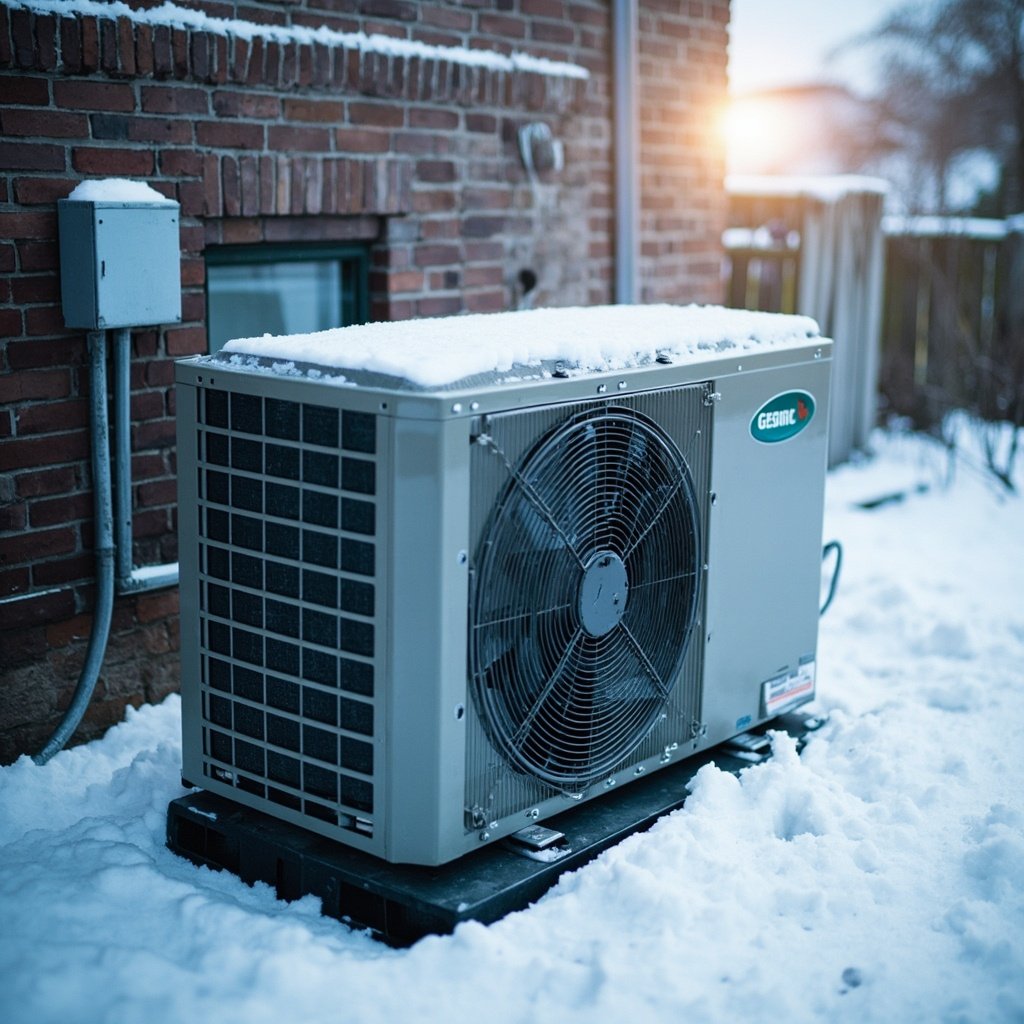
A heat pump that runs continuously — never shutting off or only short-cycling briefly before restarting — is not necessarily broken. Learn how heat pumps work → A heat pump running constantly in cold weather can be normal if the outdoor temperature is below the unit’s balance point, but it can also indicate problems: low refrigerant charge, a failing compressor, frozen coil, restricted airflow, or a thermostat set too aggressively. Identifying whether your continuous-running heat pump is a performance issue or a failure symptom requires checking a few accessible components before calling a technician.
Normal vs. Abnormal Heat Pump Running Behavior
In heating mode, a heat pump running constantly is expected when outdoor temperatures are below its balance point (typically 25–40°F depending on the unit’s capacity rating) — because the heat pump’s heating output at those temperatures is insufficient to meet the full heating load of the home. The heat pump runs continuously, producing whatever heat it can, while auxiliary heat (electric resistance strips) supplements the gap. In this scenario, the heat pump is functioning normally — just working hard in unfavorable conditions.
Abnormal continuous running occurs when:
- The home cannot reach thermostat setpoint even after extended operation (indicates insufficient heating capacity or a system fault)
- The heat pump cycles on and off every 5–15 minutes without ever achieving steady-state operation (short-cycling)
- The outdoor unit runs but the indoor air is not warming (refrigerant, airflow, or compressor problem)
- The unit runs continuously in moderate outdoor temperatures (above 40°F) without the home reaching setpoint (system fault)
The Balance Point Explained
Every heat pump has a balance point — the outdoor temperature at which the heat pump’s heating output exactly matches the home’s heating demand at the thermostat setpoint. Below the balance point, the heat pump produces less heat than the home needs, and supplemental heating (auxiliary heat) must make up the difference.
For a typical mid-sized home in climate Zone 5 (average winter low of 10–20°F):
- The balance point for a standard heat pump (8–9 HSPF) is approximately 30–35°F
- Below 30°F, the heat pump works continuously and auxiliary heat runs
- A cold-climate heat pump (12+ HSPF) may have a balance point as low as 5°F
When the balance point is above your typical winter low temperature, the heat pump runs constantly all winter — this is expected behavior and not a malfunction.
Why Your Heat Pump Runs Constantly: Common Causes
Cause 1: Low Refrigerant Charge
Low refrigerant charge reduces heat pump heating output significantly — a unit with 20% less refrigerant than specified may lose 30–40% of its heating capacity at design temperature, forcing it to run continuously without meeting demand. The refrigerant is the heat-carrying medium; without the correct charge, the heat pump’s refrigeration cycle becomes inefficient and the coil temperatures drop, reducing heating output.
Signs of low refrigerant:
- High electricity bills with poor heating performance
- Ice forming on the outdoor coil despite mild temperatures
- The heat pump short-cycles (runs briefly, shuts off, runs again)
- The home is noticeably cooler than the thermostat setpoint
A heat pump should not lose refrigerant over time — if the charge is low, there is a leak. The leak must be found and repaired before recharging, per EPA Section 608 regulations. Learn about heat pump defrost problems →
Cause 2: Frozen Outdoor Coil
A heat pump with a malfunctioning defrost cycle accumulates ice on the outdoor coil. Frost accumulation restricts airflow across the coil, reducing the heat pump’s ability to extract heat from outdoor air. The unit runs continuously, struggling against the ice barrier, and produces less and less heat until it essentially stops heating.
If the coil is heavily iced, see the defrost cycle troubleshooting guide. Clear any snow or ice buildup from around and on top of the outdoor unit with a garden hose (do not chip ice off the fins — this damages the coil).
Cause 3: Restricted Airflow
Restricted airflow through the indoor air handler or outdoor coil reduces heat pump capacity and causes the system to run continuously without meeting demand. The most common airflow restriction is a clogged air filter — which homeowners can check and replace themselves. A dirty filter can reduce airflow by 50% or more.
Other airflow restriction causes:
- Closed supply vents in multiple rooms
- A failing indoor blower motor
- Dirty indoor coil (requires professional cleaning)
- Blocked return air grille
Check the air filter first — replace it with a clean filter of the correct size and observe whether heating performance improves over the next 24 hours.
Cause 4: Compressor Failure or Degradation
The scroll compressor in a modern heat pump is the component most likely to fail in older units. A failing compressor produces less heating output than rated, causing the unit to run constantly in a futile attempt to meet demand. Compressor failure is not a repair for most homeowners — it requires a licensed HVAC technician and in many cases justifies full heat pump replacement if the unit is over 12–15 years old.
Signs of compressor degradation:
- Unusual sounds from the outdoor unit — grinding, clicking, loud humming
- The compressor cycles on and off rapidly (short-cycling)
- The outdoor unit runs but the home heats very slowly or not at all
- High electricity bills with no corresponding heating improvement
Cause 5: Wrong-Sized Heat Pump
An undersized heat pump cannot meet the heating load of the home at design temperature — and will run continuously in cold weather regardless of its efficiency rating. A heat pump that was properly sized for a moderate climate zone but is installed in a colder zone will constantly run in winter. The solution is either to add supplemental heating or to replace the unit with a properly sized model.
A heat pump that is too large is also problematic — it short-cycles, reducing efficiency and accelerating wear. The correct sizing requires a Manual J heat load calculation. Learn how heat pump sizing works →
Cause 6: Thermostat Set Incorrectly
A thermostat that is set to an aggressive temperature in cold weather, or one that has a wide temperature swing setting (where the “on” call starts at 2°F below setpoint and the “off” happens at only 1°F above setpoint), will make the heat pump appear to run continuously even when heating normally.
Check the thermostat differential settings. If possible, lower the setpoint by 2°F overnight and see if the heat pump cycles off during the warmer part of the day. If the heat pump cycles off when setpoints are modest but runs continuously when setpoints are high, the issue is the thermostat calibration, not the heat pump.
What You Can Check Before Calling a Technician
Before calling a service technician for a heat pump running constantly, check and replace the air filter, verify that no supply vents are closed, inspect the outdoor unit for visible ice accumulation and clear it with a garden hose, check the thermostat mode and setpoint, and verify the 24V power supply to the outdoor unit at the disconnect. These checks take 15–30 minutes and may resolve the issue without a service call.
Filter Inspection and Replacement
Turn off the HVAC system at the thermostat. Locate the air filter — in the return air grille, in a slot in the air handler cabinet, or behind a panel near the indoor unit. Pull the filter out and hold it up to light. If you cannot see light through it, replace it. Standard 1-inch filters should be replaced every 1–3 months during heating season. Higher-efficiency filters (MERV 8–13) last 3–6 months.
Outdoor Unit Inspection
- Snow or ice accumulated on the coil and fan housing
- Debris (leaves, grass clippings, branches) blocking the coil fins
- The base pan (drip pan beneath the unit) is full of water and frozen over
- The unit is vibrating or making unusual sounds
- The disconnect box near the unit is fully seated and the fuse/breaker is not tripped
Clear any visible blockages with a garden hose. Do not use a pressure washer or sharp tools on the coil fins.
Thermostat Verification
- Set the thermostat to 5°F below the current room temperature to call for heat
- Verify the heat pump outdoor unit starts (the compressor hums, the outdoor fan spins)
- After 5 minutes, feel the air coming from the supply vents — it should be warmer than room temperature (typically 85–95°F for a heat pump in moderate weather)
- If the air is room temperature or cooler, the heat pump is running but not heating — this requires professional service
When to Call a Professional
Call a professional HVAC technician if the heat pump runs but produces no warm air after 30 minutes, if there is ice on the coil that does not melt within 30 minutes during defrost, if the outdoor unit makes grinding or clicking sounds, or if the home cannot reach temperature even in moderate outdoor temperatures (above 40°F). These symptoms indicate compressor issues, refrigerant problems, or defrost control failures that require professional diagnosis and repair.
Professional diagnostic costs typically run $150–$300 for a service call and fault diagnosis. Component repairs (refrigerant recharge, defrost board replacement, reversing valve repair) range from $200–$800 depending on the part and labour. Compressor replacement typically runs $800–$1,800 in parts and labour — often justifying unit replacement if the heat pump is over 12 years old.
Heat Pump Running Constantly FAQ
How many hours per day should a heat pump run in winter?
In moderate weather (above the balance point), a properly sized heat pump may run 8–12 hours per day total, cycling on and off to maintain temperature. In cold weather below the balance point, it may run 16–24 hours per day with auxiliary heat supplementing it. Running 24 hours a day in temperatures above 35°F indicates a problem. Running 24 hours a day in temperatures below 20°F may be normal for a standard-efficiency heat pump — a cold-climate unit is designed to reduce this.
Does a heat pump running constantly use more electricity?
Yes — a heat pump that runs continuously uses more electricity than one that cycles on and off. However, a heat pump running continuously in cold weather is still more efficient than electric resistance heat (which would cost 3–4 times more for the same heating output). The goal is to ensure the unit is running efficiently, not to make it cycle off. If it’s running constantly but the home is at temperature, the system is working as designed.
Will turning the thermostat down make the heat pump run less?
Yes — lowering the thermostat setpoint reduces the heating demand, allowing the heat pump to reach setpoint faster and cycle off. Turning the thermostat down 2–3°F when leaving the house or at night (if using a zoning system or separate room thermostats) reduces runtime and energy use. Setting the thermostat back 7–10°F for 8 hours per day can save approximately 10% on heating costs.
Why does my heat pump run constantly but the house is still cold?
If the heat pump is running continuously but the home is still below setpoint, the unit is not producing enough heat to meet demand. This is caused by: insufficient heating capacity (undersized heat pump), low refrigerant, restricted airflow, a failing compressor, or outdoor temperatures below the balance point. In the first three cases, the problem is repairable. In the last two, professional service or unit replacement may be needed.
Should I switch to emergency heat if the heat pump runs constantly?
Only if the heat pump has stopped producing heat entirely or has failed completely. Switching to emergency heat when the heat pump is running but struggling is wasteful — emergency heat (electric resistance) costs 2–4 times more per BTU than the heat pump’s output. Use emergency heat only when the heat pump fails to heat at all, not when it’s running slowly.