
What Factors Affect Heat Pump Installation Cost?
<a href="/heaheat pumps t-pumps-2/”>Heat pump ins<a href="/heatypes of heating systems ting-system-installation/”>heating system installation tallation cost is primarily determined by the unit’s efficiency tier, whether you need ductwork modifications, your home’s size, and whether electrical panel upgrades are needed. Air-source heat pump installations typically range from $5,500 to $13,000 installed, with geothermal systems running $15,000–$30,000.
Key Cost Factors
| Factor | Impact on Cost | Details |
|---|---|---|
| Heat pump type | $2,000–$7,000 (equipment) | Standard, high-efficiency, or cold-climate; ducted vs. ductless |
| Home size | $1,500–$4,000 | Larger homes need larger, more expensive units |
| Ductwork condition | $500–$8,000 | Sealing, repair, or new duct installation |
| Electrical panel | $300–$1,500 | May need 200-amp upgrade for heat pump |
| Installation complexity | $500–$2,000 | Accessibility, location, new vs. replacement |
| Heat pump efficiency | $1,000–$3,000 | Higher HSPF/SEER = higher equipment cost |
The equipment cost is only part of the total. Always get a quote that includes all installation aspects—labor, electrical work, ductwork modifications if needed, and permits.
How Do You Get Accurate Heat Pump Quotes?
Get accurate heat pump quotes by scheduling in-person assessments with at least three licensed <a href="/choosing-hvac-conchoosing an HVAC contractor tractor-2/”>HVAC contractors who have specific heat pump experience—not just general HVAC companies. Heat pump installation has different requirements than furnace work, and not all contractors are equally trained in heat pump sizing, refrigerant handling, and low-temperature performance optimization.
The Quote Process
- Search for heat pump specialists — look for contractors with NATE-certified heat pump technicians, manufacturer heat pump certifications (Mitsubishi, Fujitsu, Carrier, etc.), and specific experience with the type of heat pump you’re considering (central, mini split, or geothermal).
- Request in-person assessments — heat pump sizing requires a Manual J calculation that accounts for your home’s square footage, insulation, window efficiency, climate zone, and ductwork condition. Phone quotes are unreliable.
- Get itemized estimates — a proper quote includes:
– Heat pump model and efficiency ratings (HSPF, SEER)
– Indoor unit type (air handler, wall units, ceiling cassettes for minmini split vs central air i splits)
– Installation labor and materials
– Electrical modifications (if needed)
– Thermostat and control upgrades
– Permits and inspection fees
– Warranty terms
- Verify refrigerant handling credentials — EPA Section 608 certification is required to purchase and handle refrigerants. Verify your contractor holds this certification.
What Federal and State Incentives Are Available for Heat Pumps?
The Inflation Reduction Act (IRA) provides a 30% federal tax credit (up to $2,000) for air-source heat pumps that meet regional efficiency specifications, and up to 30% of installed cost (with no upper cap) for geothermal heat pumps. These incentives substantially reduce the effective cost of heat pump installation.
IRA Heat Pump Tax Credits
| Heat Pump Type | Tax Credit | Key Requirements |
|---|---|---|
| Air-source (central) | 30% of installed cost, up to $2,000 | Must meet CEE regional tier; installed 2022–2032 |
| Ductless mini split | 30% of installed cost, up to $2,000 | Must meet CEE regional tier; installed 2022–2032 |
| Geothermal | 30% of installed cost, no upper cap | Installed 2022–2032; phases down after 2032 |
| Water heater (heat pump water heater) | 30% of installed cost, up to $2,000 | Must meet ENERGY STAR specifications |
State and utility incentives vary by location. Many states, utilities, and municipal programs offer additional rebates of $200–$1,500 on heat pump installations. Check the Database of State Incentives for Renewables and Efficiency (DSIRE) for incentives available in your area.
How Do You Choose the Right HVAC Contractor for a Heat Pump Install?
Choose an HVAC contractor for heat pump installation based on their heat pump-specific certifications, local experience, manufacturer credentials, and their ability to perform a proper Manual J sizing calculation. The cheapest contractor isn’t the best—heat pump installation quality varies enormously and directly affects system performance and longevity.
Contractor Selection Checklist
- NATE certification — North American Technician Excellence certification ensures technicians have passed standardized exams for HVAC installation and service.
- Manufacturer certifications — brands like Mitsubishi, Fujitsu, Carrier, and Trane certify contractors who complete specific training. Certified installers typically provide better warranty coverage.
- Heat pump experience — confirm the contractor has specific experience with the type of heat pump you’re considering (central, mini split, or geothermal). Not all HVAC contractors work with all types.
- Manual J calculation commitment — any contractor who quotes without a heat load calculation is guessing. Proper sizing is the single most important factor in heat pump performance.
- References and reviews — ask for three local references from recent heat pump installations, and check online reviews across multiple platforms.
- Warranty and service agreements — ask about the contractor’s labor warranty, how they handle warranty claims, and whether they offer annual maintenance contracts.
Frequently Asked Questions
How long does a heat pump installation take?
A standard heat pump replacement (ducted central system) takes one to two days. A multi-zone mini split installation typically takes two to three days. Geothermal installations are more complex and can take a week or more depending on the ground loop installation method.
Should I get a heat pump or a gas furnace?
In most cold and mixed climates, a heat pump is the right choice for new installations, with the best economics coming from a cold-climate certified air-source heat pump. In very cold climates (Zone 5 and colder), a dual-fuel (hybrid) system pairing a heat pump with a gas furnace offers the best combination of efficiency and reliability. If you already have gas service and a gas furnace in good condition, the economics of switching depend on your current furnace age and local fuel prices.
Can a heat pump replace my existing furnace?
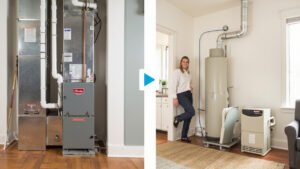
Yes—an air-source heat pump can typically replace a gas furnace in the same location, using the existing ductwork. The air handler replaces the furnace. This makes conversion straightforward in homes with functioning ducts. For homes without ducts, a mini split system avoids the cost and disruption of duct installation.
What size heat pump do I need?
Heat pump sizing requires a Manual J heat load calculation performed by your contractor. As a rough starting point, estimate 30–45 BTU per square foot of conditioned floor area in cold climates, 20–30 BTU per square foot in moderate climates. But this is a rough estimate only—actual sizing depends on insulation, windows, climate zone, and more.
What is a cold-climate heat pump and do I need one?
A cold-climate heat pump is specifically designed to maintain heating output and efficiency at temperatures as low as -15°F to -25°F. If you live in Zone 4 or colder (average winter temperature below 30°F), a cold-climate certified unit is worth the premium—it will heat your home effectively through most or all of winter without needing supplemental electric resistance heat.