Introduction
So you need new kitchen cabinet hinges, but you’re standing in the hardware aisle at Bunnings staring at about fifty different options and thinking, “What the hell am I looking at?”
Yeah, I’ve been there. Cabinet hinges seem simple enough – they’re just bits of metal that hold doors on, right? But then you start seeing terms like “35mm concealed,” “soft-close overlay,” “165-degree opening angle,” and “clip-on mounting plates,” and suddenly it feels like you need an engineering degree just to buy a hinge.
Don’t stress. I’m going to break down everything you need to know about kitchen cabinet hinges in plain English. We’ll cover the different types, whether they’re actually universal (spoiler: not really), how to measure them properly, and how to figure out which hinges you actually need.
By the end of this guide, you’ll be able to walk into any hardware store and pick the right hinges with confidence. Let’s get into it.
How Do Kitchen Cabinet Hinges Work?
Before we dive into types and sizes, let’s quickly cover how modern kitchen cabinet hinges actually work. Understanding this makes everything else much easier.
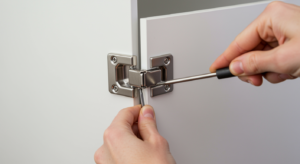
Most kitchen cabinets built in the last 30 years use concealed hinges (also called European hinges or cup hinges). Here’s how they work:
The Two Main Parts:
- The hinge body – This attaches to the door itself and sits in a circular hole (usually 35mm diameter) drilled into the door
- The mounting plate – This screws onto the cabinet frame
The hinge body clips onto the mounting plate, which means you can take doors on and off without unscrewing anything. Brilliant design, really.
The Three-Way Adjustment: These hinges have three adjustment points:
- Up and down (height)
- Left and right (side to side)
- In and out (depth)
This lets you fine-tune how the door sits, which is why they’re so popular. Older hinges didn’t have this flexibility.
The Opening Angle: Hinges are designed to open to different angles – usually 95, 110, 120, or 165 degrees. The angle you need depends on how far you want the door to swing open and whether you’ve got obstacles like walls or other cabinets nearby.
Are Kitchen Cabinet Hinges Standard Size?
Short answer: Mostly, but not entirely.
What IS Standard:
- 35mm is the standard cup diameter for concealed hinges in modern kitchens (both in Australia and globally)
- The mounting hole pattern on most hinges is fairly consistent
- Screw sizes are usually standard (typically 4mm or 5mm diameter)
What ISN’T Standard:
- The distance between mounting holes can vary by brand
- The depth of the hinge cup varies (usually 11-13mm)
- The mounting plate designs differ between manufacturers
- The hinge arm length and style can be different
So while you can usually find a replacement hinge that fits, you can’t just grab any old 35mm hinge and expect it to drop right in. You need to match a few specific measurements.
For Older Cabinets: If your kitchen was built before the 1990s, you might have different hinge sizes altogether. Older concealed hinges sometimes used 26mm cups, and really old cabinets might have traditional butt hinges or pivot hinges instead.
Are Kitchen Cabinet Hinges Universal?
Here’s the truth: Kitchen cabinet hinges are NOT truly universal, but they’re more interchangeable than you might think.
What “Universal” Actually Means: When manufacturers say a hinge is “universal,” they usually mean:
- It’ll fit standard 35mm hinge cups
- It uses standard screw sizes
- The mounting plate will fit most cabinet frames
But that doesn’t mean every hinge will work in every situation.
Why They’re Not Completely Interchangeable:
1. Overlay Type Matters Different hinges are designed for different door configurations:
- Full overlay (door covers the entire cabinet frame)
- Half overlay (for shared partitions between cabinets)
- Inset (door sits inside the cabinet frame)
You can’t just swap these around. A full overlay hinge won’t work properly on a half overlay door.
2. Brand Compatibility While many brands use similar designs, the mounting plates and clip mechanisms aren’t always compatible. A Blum hinge might not clip onto a Hafele mounting plate, for example.
3. Opening Angles If you’ve got a corner cabinet or a cabinet next to a wall, you might need a specific opening angle. A standard 110-degree hinge won’t work if you need 165 degrees of clearance.
When You CAN Swap Hinges:
- Replacing damaged hinges with the same type and brand
- Upgrading to the same overlay type (e.g., replacing standard with soft-close)
- Using high-quality aftermarket hinges designed to be compatible with major brands
When You SHOULDN’T Mix and Match:
- Different overlay types
- Different brands (unless you’re replacing all the mounting plates too)
- Different opening angles in the same cabinet run
Types of Kitchen Cabinet Hinges
Alright, let’s break down the main types you’ll come across.
1. Concealed Hinges (European Hinges)
What They Are: The most common type in modern kitchens. The hinge sits inside a cup drilled into the door, so you don’t see it when the door’s closed.
Pros:
- Clean look (no visible hardware)
- Easy to adjust in three directions
- Can be removed and reinstalled easily
- Available with soft-close mechanisms
Cons:
- Require precise drilling for installation
- More expensive than basic hinges
- Can be harder to find exact replacements for older models
Best For: Pretty much all modern kitchen cabinets
2. Soft-Close Hinges
What They Are: Concealed hinges with a built-in dampening mechanism that makes doors close gently instead of slamming.
Pros:
- Quieter kitchen (no slamming)
- Protects cabinet doors and frames from damage
- Feels more upmarket
- Prevents dishes from rattling
Cons:
- More expensive (usually $10-15 each vs $3-5 for standard)
- Dampening mechanism wears out over time (usually 5-10 years)
- Can’t be repaired when they fail – need full replacement
Best For: Any kitchen, but especially if you’ve got kids who slam doors or you want a quieter home
3. Full Overlay Hinges
What They Are: Hinges designed so the door completely covers the cabinet frame when closed.
Overlay Distance: Usually 16-20mm
When You Need Them:
- Frameless (European-style) cabinets
- Modern flat-panel kitchens
- When the door needs to cover the entire cabinet box
Recognition Tip: If your cabinet doors cover all the cabinet frame and you can’t see any cabinet box when doors are closed, you’ve got full overlay.
4. Half Overlay Hinges
What They Are: These are used when two doors share the same partition (like in a double-door cabinet).
Overlay Distance: Usually 8-10mm
When You Need Them:
- Double-door cabinets where two doors meet in the middle
- When doors need to share the same cabinet divider
Recognition Tip: Look at a double-door cabinet – each door only covers half the middle partition. That’s half overlay.
5. Inset Hinges
What They Are: Hinges that allow the door to sit completely inside the cabinet frame (flush with the face).
When You Need Them:
- Traditional or shaker-style cabinets
- Face-frame cabinets (common in American-style kitchens)
- When you want that classic furniture look
Recognition Tip: When the doors are closed, you can see the cabinet frame around all sides of the door. The door doesn’t overlap the frame at all.
6. Corner Cabinet Hinges
What They Are: Special hinges with wider opening angles (usually 165 degrees or more) for corner cabinets.
When You Need Them:
- Blind corner cabinets
- Lazy susan cabinets
- Any cabinet where the door needs to swing completely out of the way
Special Note: These often have a different arm design to allow the wider opening without hitting adjacent cabinets or walls.
7. Glass Door Hinges
What They Are: Hinges specifically designed to hold glass cabinet doors, with special mounting plates or clamps.
When You Need Them:
- Glass-fronted display cabinets
- Doors with glass panels
- Any door where you can’t drill a hinge cup
Special Feature: Often have rubber or plastic buffers to prevent the glass from cracking.
How Do You Measure Kitchen Cabinet Hinges?
Right, here’s where we get practical. If you need to replace a hinge or buy new ones, you’ll need to measure correctly. Here’s what to check:
Measurement 1: Cup Diameter
What It Is: The diameter of the circular hole drilled into the door where the hinge sits.
How to Measure:
- Remove the hinge from the door
- Measure straight across the cup hole
- Most modern hinges are 35mm
Why It Matters: You need a hinge that fits the existing hole. Drilling a new hole in a different size is a pain and can weaken the door.
Measurement 2: Cup Depth
What It Is: How deep the hinge cup sits into the door.
How to Measure:
- Measure from the door surface to the bottom of the cup hole
- Usually 11mm, 12mm, or 13mm
Why It Matters: If the hinge cup is too shallow, the hinge won’t sit properly. Too deep, and it might bottom out before it’s secure.
Measurement 3: Hinge Hole Distance (Drilling Distance)
What It Is: The distance from the edge of the door to the center of the hinge cup.
How to Measure:
- Measure from the edge of the door to the center point of the cup hole
- Common measurements: 3mm, 4mm, or 5mm
Why It Matters: This affects how the door sits on the cabinet. Wrong distance = door won’t align properly.
Measurement 4: Door Thickness
What It Is: How thick your cabinet door is.
Standard Thickness: Most cabinet doors are 16-22mm thick
Why It Matters: Some hinges are designed for specific door thicknesses. If your doors are unusually thick or thin, you might need special hinges.
Measurement 5: Overlay Measurement
What It Is: How much the door overlaps the cabinet frame.
How to Measure:
- Close the door
- Measure how far the door edge extends past the cabinet frame edge
- Full overlay: usually 16-20mm
- Half overlay: usually 8-10mm
- Inset: 0mm (door sits inside frame)
Why It Matters: This determines which type of hinge you need. Get this wrong, and your doors won’t line up properly.
Measurement 6: Opening Angle
What It Is: How far the door can swing open.
Common Angles:
- 95 degrees (standard, limited space)
- 110 degrees (most common)
- 120 degrees (wide opening)
- 165 degrees (corner cabinets)
How to Check: Open your current door as far as it’ll go and estimate the angle, or check the hinge markings (sometimes stamped on the hinge body).
Why It Matters: If you need doors to open wide (corner cabinets, tight spaces), you need the right opening angle.
Measurement 7: Mounting Plate to Cup Distance
What It Is: The horizontal distance from the mounting plate to the hinge cup.
Why It Matters: This is usually standardized within brands but can vary. If you’re mixing brands, check this measurement.
How to Choose the Right Replacement Hinges
Now that you know what to measure, here’s how to actually pick the right hinges:
Step 1: Take the Old Hinge With You
Seriously, just take one of your existing hinges to Bunnings or your local hardware store. It’s the easiest way to get a perfect match.
Step 2: Match These Key Specs
- Cup diameter (probably 35mm)
- Overlay type (full, half, or inset)
- Opening angle (if it matters for your cabinet location)
- Brand (if you want perfect compatibility)
Step 3: Decide on Features
Standard vs Soft-Close: Soft-close costs more but is worth it if you want a quieter kitchen. You can mix and match – put soft-close on the doors you use most and standard hinges on less-used cabinets.
Budget vs Quality: Cheap hinges ($3-5 each) will do the job but might not last as long. Mid-range hinges ($7-10) are usually the sweet spot. Premium brands like Blum ($12-15+) are worth it if you want long-term reliability.
Step 4: Count How Many You Need
General Rule:
- Small doors (up to 600mm high): 2 hinges
- Medium doors (600-1200mm): 3 hinges
- Large doors (over 1200mm): 4 hinges
Add a couple of extras to your order in case you strip a screw or need to replace another hinge down the track.
Popular Hinge Brands in Australia
Here’s a quick rundown of brands you’ll find in Aussie hardware stores:
Blum
Quality: Top-tier Price: $$$ (premium) Known For: Excellent soft-close mechanisms, long-lasting, precise engineering Best For: High-end kitchens, renovations where quality matters
Hafele
Quality: High Price: $$ (mid to premium) Known For: Wide range of styles, good quality, professional-grade Best For: Professional installations, quality renovations
Hettich
Quality: High Price: $$ (mid to premium) Known For: Innovative designs, good soft-close options Best For: Modern kitchens, quality builds
Bunnings/Kaboodle Brand
Quality: Budget to mid-range Price: $ (budget-friendly) Known For: Affordable, readily available Best For: DIY projects, rental properties, budget renovations
Generic/Unbranded
Quality: Budget Price: $ (cheapest) Known For: Getting the job done on a tight budget Best For: Temporary fixes, low-use cabinets
Pro Tip: Stick with one brand throughout your kitchen if possible. Mixing brands can lead to inconsistent feel and performance.
Can You Mix Different Hinge Types in One Kitchen?
Short Answer: You can, but it’s not ideal.
When It’s Fine:
- Mixing standard and soft-close (as long as they’re the same overlay type and brand)
- Using different opening angles for different cabinet locations
- Having different hinge types for different door sizes
When It’s Problematic:
- Mixing full overlay and half overlay (doors won’t line up)
- Mixing brands (doors might feel different, adjustment might vary)
- Mixing old and new hinge styles (they might not match visually if you can see them)
Best Practice: Use the same type throughout for consistency, but prioritize soft-close on your most-used cabinets if you’re on a budget.
Installing New Hinges: What You Need to Know
If you’re installing hinges on brand new cabinet doors, here’s what you need:
Tools Required:
- 35mm Forstner bit (for drilling hinge cups)
- Drill
- Measuring tape
- Pencil
- Screwdriver
- Hinge jig (makes drilling way easier and more accurate)
The Process (Simplified):
- Mark where the hinge cups need to go (usually 90-120mm from top and bottom of door)
- Drill the hinge cups using the Forstner bit
- Attach the mounting plates to the cabinet frame
- Screw the hinges into the door cups
- Clip the hinges onto the mounting plates
- Adjust until the doors align properly
Honestly? If you’re installing hinges from scratch, consider getting a tradie to do it. The drilling needs to be spot-on, or your doors will be wonky. Replacing existing hinges is an easy DIY, but new installation is trickier.
Troubleshooting Hinge Compatibility Issues
Sometimes you buy hinges and they don’t quite work. Here’s how to sort common problems:
Problem: Hinge Won’t Clip onto Mounting Plate Solution: You’ve probably got incompatible brands. Either return the hinges or replace all the mounting plates with ones that match your new hinges.
Problem: Door Won’t Close Properly Solution: Check you’ve got the right overlay type. Full overlay hinges on a half overlay door (or vice versa) won’t work.
Problem: Hinge Opening Angle Is Wrong Solution: You need hinges with a wider opening angle. This happens a lot with corner cabinets.
Problem: Screws Won’t Line Up with Existing Holes Solution: Different brands use different mounting hole patterns. You might need to fill old holes and drill new ones, or just find hinges that match your existing pattern.
Frequently Asked Questions
What size are most kitchen cabinet hinges?
Most modern kitchen cabinets use 35mm concealed hinges. This is the standard in Australia and pretty much worldwide for European-style cabinets.
Can I replace kitchen cabinet hinges with different ones?
Yes, but you need to match the overlay type (full, half, or inset) and make sure the cup size is the same. You can upgrade from standard to soft-close as long as they’re the same type.
How do I know what overlay my hinges are?
Close your cabinet door and look at how much it overlaps the cabinet frame. Full overlay covers the entire frame (16-20mm). Half overlay only covers part of it (8-10mm). Inset sits inside the frame with no overlap.
Are Blum hinges worth the extra money?
For most people, yes. They last longer, adjust more smoothly, and the soft-close mechanisms are more reliable. If you’re doing a quality kitchen renovation, Blum is a safe bet.
Can I use soft-close hinges on old cabinets?
Absolutely! As long as your old cabinets have 35mm hinge cups, you can swap in soft-close hinges. It’s a great upgrade that makes old kitchens feel more modern.
Do I need special hinges for heavy doors?
Yes, for solid timber doors or doors with heavy glass panels, look for heavy-duty hinges rated for the weight. Standard hinges might sag over time with heavy doors.
How many hinges do I need per door?
Two hinges for small doors (under 600mm), three for medium doors (600-1200mm), four for large or heavy doors (over 1200mm).
Conclusion
Right, that’s everything you need to know about kitchen cabinet hinges. Yeah, there’s more to them than you might’ve thought, but once you understand the basics – overlay type, cup size, and opening angle – the rest falls into place.
Here’s the key takeaway: Kitchen cabinet hinges aren’t truly universal, but they’re pretty standardized. If you measure carefully and match the overlay type and cup size, you’ll find a hinge that works. And if you’re ever unsure, just take your old hinge to the hardware store and get them to match it.
Whether you’re replacing one broken hinge or upgrading your whole kitchen to soft-close, you now know what to look for and what questions to ask. No more standing confused in the hinge aisle wondering what the hell you need.
Now go forth and hinge with confidence, mate.